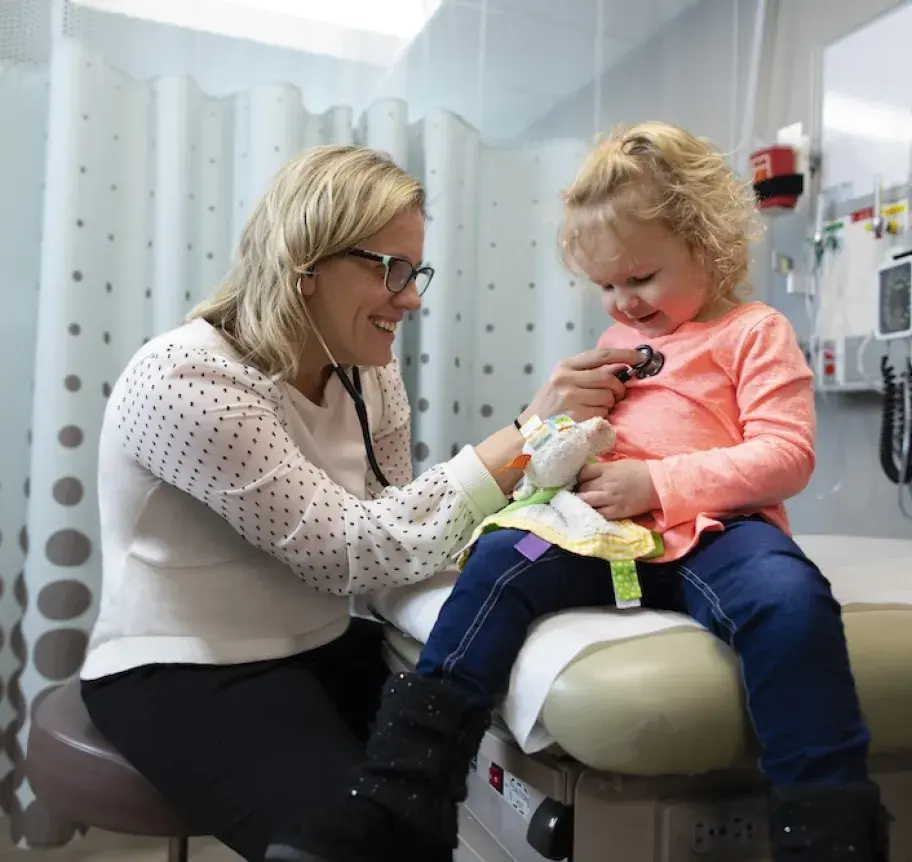

Nurse with child
Online

Nursing Post-Graduate Certificate

The Nursing Post-Graduate Certificate programs in Creighton’s College of Nursing will help you build on your skills and knowledge, explore new professional avenues and expand your leadership role in healthcare. Perhaps you’ve already earned your graduate nursing degree, but now you have new goals. Maybe you’d like to expand your nursing role. Or maybe you have an interest in an area outside of what you’ve previously studied. If any of these situations sound familiar, a post-graduate nursing certificate could be just what you're seeking.

Choose from six specialty areas:

  • Adult-Gerontology Acute Care Nurse Practitioner (AG-ACNP)
  • Family Nurse Practitioner (FNP)
  • Neonatal Nurse Practitioner (NNP)
  • Nursing Education
  • Pediatric Acute Care Nurse Practitioner (PNP-AC)
  • Psychiatric-Mental Health Across the Lifespan Nurse Practitioner (PMHNP) 

Post-Master’s APRN and Nursing Education Certificates

This program offers post-graduate Advanced Practice Registered Nurse (APRN) or nursing education certificates for advanced practice nurses who already hold a graduate nursing degree and want to earn certification in a different patient population. Here, you’ll gain the advanced knowledge and skills you need to be a leader in today’s challenging healthcare environment and add a new population focus. 

Program Outcomes

Upon graduation, Creighton students will have the skills to:

  • Formulate a professional framework integrating reflective practice that facilitates ethical reasoning, cultural humility and advocacy anchored in social justice
  • Demonstrate proficiency in analyzing and utilizing evidence form nursing and other relevant disciplines to improve practice
  • Demonstrate competency in the new advance nursing role


Post-Master's Nursing Certificate Admission Requirements

Due to the specific features and requirements of these programs, international students cannot be admitted to any of the Nurse Post-Graduate Certificate programs. Unique situations may be discussed with an admissions specialist. 

To be considered for admission, you must have:

  • At minimum an MSN from an ACEN- or CCNE-accredited college or university
  • An active, unencumbered RN license
  • An active, unencumbered APRN-NP license for all Nurse Practitioner (NP) certificate programs 

Professional nursing work experience is also required prior to clinical courses:

  • Family NP and Adult-Gerontology Acute Care NP: A minimum of 2,000 hours of professional nursing work experience in direct patient care.
  • Psychiatric Mental Health Across the Lifespan NP: A minimum of 2,000 hours of direct patient care in psychiatric mental health.
  • Neonatal NP: A minimum of 4,000 hours of direct care in level III or IV NICU.
  • Pediatric Acute Care NP: A minimum of 2,000 hours of direct care in pediatrics. Only 500 hours of neonatal experience will be counted towards the required 2,000 pediatric clinical hours.  

Along with the application, please submit the following: 

  • Official transcripts from all educational institutions attended*  
  • Your resume or curriculum vitae
  • Three letters of recommendation; one from a supervisor/employer who can speak to your performance in an academic or professional setting; for the Neonatal NP certificate program, one Neonatal Nurse Practitioner or Neonatologist is also strongly recommended
  • A personal statement speaking to your long- and short-term goals 

Verification of clinical/practicum hours completed will be required post-admission. 

*Note that any course work taken at an accredited institution outside of the United States must be evaluated course-by-course by a NACES approved credentialing agency. View a list of approved agencies. Official evaluations must be sent directly from the agency to Creighton University. 

Personal Statement

The personal statement should be 2-3 pages in length (double-spaced) and should include the following: 

  • Your reasons for selecting Creighton University and why you are considering a specific track  
  • A description of future professional goals related to leadership and/or evidence-based practice.
  • How you believe advanced nursing education will prepare you to reduce health disparities, promote cultural awareness or engage in population-focused health promotion activities
  • If applicable, provide a rationale for any of the following discrepancies on your transcripts and an explanation of what has changed to promote your success in this program:
    • Grades that are lower than a C
    • Courses with a W (withdrawals)
    • Extended leaves, previous enrollment in professional programs, misconducts, dismissals and any other considerations 

Dates and Deadlines for APRN and Nursing Education Certificates

The following programs begin in January; applications are due by May 1.  

  • Pediatric Acute Care Nurse Practitioner Certificate
  • Adult-Gerontology Acute Care Nurse Practitioner Certificate
  • Neonatal Nurse Practitioner Certificate
  • Nursing Education Certificate 

The following programs begin in May; applications are due by October 1.  

  • Adult-Gerontology Acute Care Nurse Practitioner Certificate
  • Psychiatric-Mental Health Across the Lifespan Nurse Practitioner Certificate
  • Family Nurse Practitioner Certificate 

Career opportunities with your post-master’s certificate.

With a post-master’s APRN certificate or the post-graduate Nursing Education certificate from Creighton, you can expand your scope of practice:

  • Adult-Gerontology Acute Care Nurse Practitioners practice in ICU, ED, step-down, and inpatient specialty teams managing acute and complex adult/gero conditions
  • Family Nurse Practitioners deliver primary care across the lifespan in clinics, community health centers and family practices
  • Neonatal Nurse Practitioners manage the health of infants in Level I–IV nurseries, labor and delivery units, specialty children's hospitals and more
  • Pediatric Acute Care Nurse Practitioners serve in pediatric ED, PICU, hospital medicine and subspecialty services
  • Psychiatric-Mental Health Across the Lifespan Nurse Practitioners provide psychotherapy and medication management in outpatient, inpatient, community and telepsychiatry settings
  • Nursing Educators are prepared to teach, mentor, and build the nursing workforce in roles such as academic faculty, clinical instructors, simulation/skills lab educators and staff development specialists

APRN / Nurse Practitioner Specializations + Education Pathway

Lifelong learning is important to me because lifelong teaching is integral to my practice. I am committed to meeting my patients’ needs, and to do that, I need to continue to develop and grow as a person. 

Amanda Grosse

DNP’22, APRN

Psychiatric Mental Health Nurse Practitioner post-grad certificate student

Tuition, Cost and Financial Aid

Tuition is reviewed annually. Visit our Cost and Aid page for current cost information, our net-price calculator and financial-aid information. To help make your graduate studies more affordable, we encourage you to complete and submit the FAFSA

Image
student on laptop sitting at a table

Nurse Faculty Loan Program (NFLP)

Students enrolled in post-graduate certificate programs that intend to work as educators after their graduation are eligible to apply for Nurse Faculty Loan Program (NFLP) funding. Loan recipients may have up to 85% of their loan forgiven by working full-time as a Nurse Educator after graduating from their program. To be eligible for NFLP, a student must: 

  • Be a citizen of the U.S. or a lawful, permanent resident of the U.S. and its territories
  • Be in good academic standing (as defined by the College of Nursing)
  • Have completed their FAFSA  
  • Be enrolled in the Nursing Education Post-Graduate Certificate program either part- or full-time 

Please read this document for additional details about borrowing limits, loan forgiveness work, employment eligibility, repayment and other details related to the NFLP.

Frequently Asked Questions

Why are the application deadlines so far in advance of the start dates?

Students begin their clinical rotations immediately upon starting the program. The application deadlines are far in advance because clinical placement requests are due up to four months before the first term. 

Since the program is online, can I attend from anywhere in the United States?

Due to regulatory requirements in the following states, we are unable to accept or enroll students who intend to reside in any of these states while pursuing a graduate nursing degree: Delaware, Louisiana, Maryland, Massachusetts, New Hampshire, New York, Tennessee and Washington

I attended Creighton University for my previous degree. Do I still need to request Creighton University transcripts?

No. We can access those transcripts for you. However, any non-Creighton transcripts that you submitted to Creighton for your previous degree may need to be resent. 

Will I need to find my own preceptors?

Yes. Students are responsible for finding their own preceptors. For specific questions about preceptors and hours required, please contact a nursing enrollment specialist

Image
CCNE logo Commission on Collegiate Nursing Education

Accreditation

The post-graduate APRN certificate program at Creighton University is accredited by the Commission on Collegiate Nursing Education

State Licensure Requirements and Certification Eligibility

Professional licensure requirements are determined solely by each state and may change without notice to Creighton. While our information is updated annually, Creighton cannot guarantee continuous accuracy. We recommend that current or prospective students review program-specific documents on our Academic Regulations page, or consult the appropriate licensing agency in the state where they plan to practice to confirm updated requirements. Creighton cannot guarantee that any student will attain state-established licensure or certification in any field or jurisdiction.  

However, most our certificate programs offer students eligibility for national certification.  

  • Adult-Gerontology Acute Care Nurse Practitioner Post-Graduate Certificate Program: Students who complete this program meet eligibility for national certification through the American Association of Critical-Care Nurses (AACN) and the American Nurses Credentialing Center (ANCC).
  • Family Nurse Practitioner Post-Graduate Certificate Program: Students who complete this program meet eligibility for national certification through the American Nurses Credentialing Center (ANCC) and the American Academy of Nurse Practitioners Certification Board (AANPCB).
  • Neonatal Nurse Practitioner Post-Graduate Certificate Program: Students who complete this program meet eligibility for national certification through the National Certification Corporation (NCC).
  • Pediatric Acute Care Nurse Practitioner Post-Graduate Certificate Program: Students who complete this program are eligible to take the acute care national certification exam through the Pediatric Nurse Certification Board (PNCB).
  • Psychiatric Mental Health Nurse Practitioner Post-Graduate Certificate Program: Students who complete this program meet eligibility for national certification through the American Nurses Credentialing Center (ANCC) and the American Academy of Nurse Practitioners Certification Program (AANPCP). 

Note that all the above national certification credentialing agencies are accepted in all 50 states as the initial step in seeking licensure as an Advanced Practice Registered Nurse (APRN). 

State Regulatory Requirements 

Due to regulatory requirements in the states listed below, we are unable to accept or enroll students in a nursing post-graduate certificate program who intend to reside in any of these states while pursuing the certificate:  

  • Delaware
  • Louisiana
  • Maryland
  • Massachusetts
  • New Hampshire
  • New York
  • Tennessee  
  • Washington 

This information will be updated as state regulatory requirements change. For all other states not listed above, regulations vary depending on the program and/or individual situation. Please email the College of Nursing or contact us at 402.280.3492 for questions regarding a specific state. 


Contact Us

College of Nursing

2500 California Plaza 
Omaha, NE 68178 
Phone: 402.280.2000 or 800.544.5071 
Fax: 402.280.2045 

Close SidebarClose Sidebar