This meditative technique can help clinicians reduce stress and reconnect

Burnout is rising across healthcare, leaving clinicians feeling overwhelmed and disconnected. With a growing need to retain skilled professionals, preventing burnout is essential. Here, we explored how compassion and connection support well-being. In this blog, we focus on another proven approach: self-connection through Transcendental Meditation and contemplative practice.
The practice of Transcendental Meditation
Meditation is often thought of clearing your mind entirely or reaching a higher state of consciousness. In more practical terms, Transcendental Meditation is a simple, time-effective, scientifically supported technique that activates the relaxation response, stimulating the parasympathetic nervous system, reducing stress and improving overall health.
How to do it:
- Find a quiet space. Sit comfortably in a chair or on a cushion. Keep your posture relaxed but upright.
- Pick a word or a short phrase that has personal meaning, or even a neutral word like “one.”
- Close your eyes and silently repeat your word or phrase at a comfortable pace.
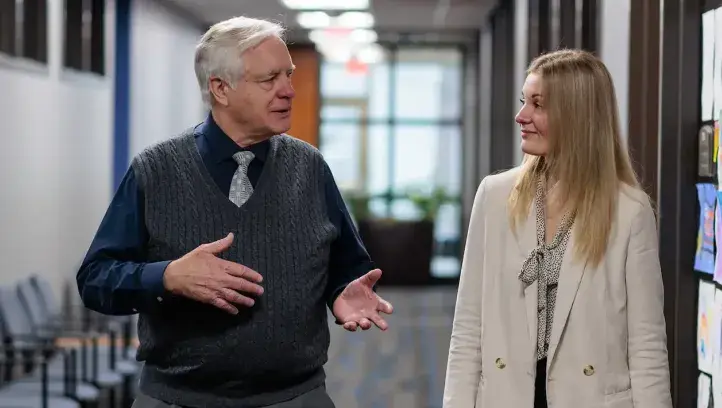
“And that’s all there is to it,” says Tom Lenz, PharmD, Creighton professor. Except, during this practice, you’ll notice your mind drifting away from your word or phrase. Thoughts about patient encounters, tasks or personal concerns may come flooding in.
What you do next is the important part: don’t fight your thoughts. Simply let them pass and gently return to your word or phrase.
“It's not ‘how long I can hold my concentration with the word,’” says Lenz. Rather, meditation is the process of letting go. “That’s the benefit of it. And that’s the point missed by a lot of people in meditation.”
Lenz notes that the “letting go” process subtly transforms perception.
“It changes the way you see. It changes the way you are. And not only does that, but it also lowers your blood pressure, increases circulation and reduces anxiety and depression. It’s even been shown to directly oppose gene activity that can lead to stress-related chronic illness,” Lenz adds.
It’s simple to understand but challenging to master. Practicing for just a few minutes a day can help you let go, connect with yourself and reduce stress.
Exploring contemplation
Contemplative practice builds on meditation by focusing on awareness and purposeful connection, often with a spiritual or reflective intention.
How to do it:
- Choose a sacred word that signifies connection to purpose or God
- Sit quietly, repeat the word briefly, then let it fall away
- Rest in the stillness, open to receiving the present moment
- When thoughts arise, gently return to your word, then let it fall away
“This practice opens you to receive and be in relationship with God,” Lenz says.
He explains that contemplative practice deepens awareness—not of more things, but of knowing with more of yourself. In Ignatian language, this reflects the spirit of the Magis: becoming more attentive, more grounded and more present so your actions can be guided by greater clarity and intention.
While contemplative practice uses nearly the same technique as Transcendental Meditation, Lenz notes that the intention shifts. Meditation aims primarily at stress reduction and physiological calm, while contemplation invites a reflective, spiritual openness—fostering connection, discernment and a grounded sense of purpose.
Integrative care education at Creighton
Compassion and connection techniques like meditation and contemplation are part of a larger shift happening in healthcare to avoid burnout, impact patient behavior change and ultimately improve health outcomes.
Continuing education plays a pivotal role in this transformation.
Creighton’s Integrative Care Certificate—a self-paced, 16-hour, CE-accredited program—helps clinicians integrate contemporary, evidence-informed approaches into their daily practice.
Structured around two online badges, the program equips learners to deliver whole-person care through topics such as mind–body medicine, social determinants of health, health coaching and early signals of burnout. Guided by faculty like Lenz, clinicians gain practical tools and a renewed perspective on compassion, supporting both personal resilience and better care for every patient they serve.