Creighton’s Alaska Hybrid Pathway: Shaping OT leaders for 18 years
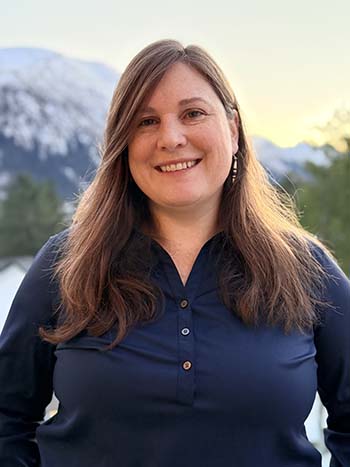
For Kathleen Hansen, OTD’11, OTR/L, member of Creighton’s first Alaska Hybrid Pathway cohort 18 years ago, occupational therapy was always more than helping people with mobility, recovery and skill development.
It’s always been about heart.
A profession for and with others
The field is interdisciplinary in nature, requiring practitioners to consider physical, cognitive and sensory and emotional challenges of those they serve.
Hansen’s first exposure to occupational therapy came through an Easterseals camp, where she served as a camp counselor in high school. She saw how occupational therapists supported individuals in everyday environments.
“It really stuck with me on how impactful occupational therapists can be to support individuals in accessing the environment around them,” she says.
Choosing her career in occupational therapy
Throughout her undergraduate schooling, Hansen knew healthcare was her career path. She continued to draw on her early exposure to OT, eventually deciding on the profession as her career choice.
After earning her degree from St. Joseph’s University, a Jesuit university in Philadelphia, she moved to Juneau, Alaska, to serve with the Jesuit Volunteer Corps, supporting outdoor recreation opportunities for individuals of all abilities.
“This included adaptive skiing, camping trips, after school programs, connection with low vision participants, as well as community recreation programs for adults who experienced significant mental health challenges,” she says.
From that point on, Juneau was home. However, with limited opportunities to grow professionally, she moved to Anchorage, where she enrolled in Creighton’s Doctor of Occupational Therapy (OTD) Alaska Hybrid Pathway program, offered in partnership with the University of Alaska Anchorage (UAA).
The OTD Alaska Hybrid Pathway
The Alaska Hybrid Pathway, established in 2008 in partnership with UAA, is designed to meet the unique healthcare needs of Alaska’s rural and underserved communities by helping students remain rooted in their communities. The program blends online coursework taught by Creighton faculty with in-person lab experiences led by local clinicians. At the time of its launch, the model represented an early and forward-thinking approach to delivering rigorous clinical education beyond a traditional campus setting.
And Hansen can attest to this. “I loved the dynamic aspect to the hybrid approach, Creighton's commitment to be at the forefront of innovation and its roots in Jesuit education,” she says.
Learning in place across a vast state
Although Alaska is vast geographically, its Indigenous communities are interconnected through cultural ties that shape healthcare delivery and learning. Hansen describes the program’s place-based approach as transformative.
Learning in place is especially important given the weather determinates to care, Hansen says. Patients are sometimes transferred through a mix of cars, airplanes, boats, ATVs or snowmachines, depending on how remote the area is.
As such, she completed fieldwork across Alaska and participated in interdisciplinary initiatives, including the Leadership Education in Neurodevelopmental and Related Disabilities (LEND) fellowship and Fetal Alcohol Spectrum Disorders training and research through the University of Washington as part of her Creighton capstone.
“Learning in place elevated the relevance and depth of the program. Building connections with occupational therapists and providers across the state was an incredible bonus,” she says, adding that these experiences deepened her understanding of healthcare delivery in a large, geographically complex state.
Not only did learning from 3,351 miles away not hinder her experience, says Hansen. In fact, it enhanced it.
"Despite the distance,” Hansen says, “the support and connection from Creighton faculty like Dr. Bracciano in Omaha made it feel as though we were right on campus. The program truly met the needs of Alaskans and has supported the growth of and access to occupational therapists in our state.”
A lasting impact in occupational therapy
Following graduation, Hansen traveled to Nome, Alaska, to provide therapy services through Norton Sound Health Corporation and surrounding village communities as a scholarship recipient with the Alaska Infant Learning Program. Back home in Juneau, her career has since spanned multiple care settings across Southeast Alaska. She now works with the SouthEast Alaska Regional Health Consortium (SEARHC), a non-profit health consortium that serves the health interests of Southeast Alaska. There, she has helped expand rehabilitation services and improve access to care closer to home.
“From my capstone needs assessment at Creighton, to seeing and being a part of growth in rehabilitation services in our region, it’s been an amazing opportunity,” Hansen says. “We are bringing high quality healthcare closer to home.”
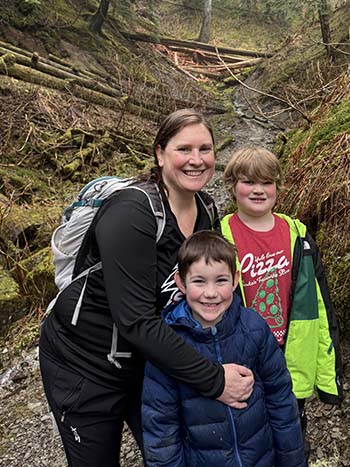
Among her proudest achievements are becoming a mother and contributing to the growth of pediatric and adult neurological services in the region through SEARHC. Committed to continued growth, Hansen is also pursuing an executive MBA at the University of Colorado to further develop her leadership skills.