Is law school worth the cost?
How to compare programs — and why Creighton delivers
Choosing a law school is more than just a financial decision. It is a decision about who will be in your corner for the next three years and, if you choose well, for your whole career.
For prospective students comparing tuition costs, scholarship offers and employment stats, numbers matter. But they only tell part of the story. The deeper question is what kind of institution stands behind those figures. Does the school know your name? Does it care whether you pass the bar exam, not just whether you graduate? When you need someone to advocate for you, guide you through a decision or connect you with the right contact at the right firm, is anyone actually picking up the phone?
At Creighton University School of Law, those questions have answers. The school has built its identity around a simple yet demanding idea: that getting students in the door is only the beginning of the job. The real work is getting them through — through the rigor of legal education, through the bar exam, into a career and into a professional community that does not dissolve when the diploma is handed over. That commitment, embedded in more than a century of Jesuit education in the heart of Omaha's legal market, is what turns a law degree into a return on investment that compounds long after the loans are repaid.
What you're actually paying — and what you're getting
Merit scholarships are awarded on a rolling basis, typically within three weeks of admission, and the evaluation goes well beyond LSAT scores and undergraduate GPA. The admissions committee reviews letters of recommendation, personal statements and evidence of community involvement and leadership. Students are encouraged to file the FAFSA as early as possible, which allows the school to build a complete financial picture — showing not just scholarship-adjusted tuition but also projected costs for housing, food and transportation.
The majority of Creighton Law students receive scholarship support in some form. Yvonnda Summers, JD, associate dean of Student Affairs, notes that Creighton dedicates a high percentage of donations directly to scholarships. “The goal,” she says, “is to make getting a law degree attainable for students.”
Sticker price is rarely the real price. Creighton Law publishes a full, transparent breakdown of tuition, fees and projected living expenses at its cost of attendance page, and that transparency is intentional.
“There are no hidden fees,” says Dexter Turner, director of recruiting in Law Admissions. “What you see is truly what it could cost for you to attend Creighton. Our admissions team works diligently to make sure Creighton is as affordable as possible for every student.”
Investing in leaders: Law scholars and Dean's Fellows
For students who show both academic success and dedication to community, two signature programs turn that effort into something more personal.
Law Scholars are selected for distinguished academic and extracurricular records. “Our scholars serve as students who help with alumni and important guests,” Summers says. “Being outgoing, involved in their communities and showing dedication to their academics is important when choosing a cohort to represent our school.”
Dean's Fellows are chosen with a different emphasis. “Our Jesuit mission is grounded in ‘for and with others,’ and the Dean’s Fellows program focuses on that pillar,” she says. “Applicants who have a history of service on their resumes, coupled with academic achievement, make a great candidate.”
Both programs are designed to develop leaders without overwhelming them. “The program is not time-intensive,” Summers explains. “At the beginning of the academic year, the cohorts spend time together learning about leadership in large and small groups. They establish relationships and expectations with each other.” Local firms also participate, hosting networking sessions and presentations that connect students early with the professional community they are preparing to enter.
The core idea for both programs is the same philosophy that broadly defines student affairs at Creighton. “You are guaranteed to get a great legal education,” Summers says. “But student affairs hone the focus on the soft skills that come with being a lawyer — how to carry yourself as a legal professional, how to care for your mental health as you transition from student to practitioner, how to navigate the personal ups and downs that life brings.”
Location is part of the financial equation
When comparing law school offers, most prospective students start with tuition. Turner encourages them to go further.
“When you're evaluating different schools, sometimes the offers aren’t even apples to apples,” he says. “Look at what life costs in the city you’re moving to. Living in a place like Omaha is going to be significantly cheaper than living in a major metro. That matters every single month of the three years you're there.”
Dean Joshua Fershée, JD, puts the total picture plainly: “For a lot of students, our cost of attendance is highly competitive with any school they would be looking at, and they’re coming to a market that has strong job outcomes and a lower cost of living.”
Owning the market: What a Creighton degree opens
Irina Fox, JD, associate dean for Research and Innovation and co-chair of the admissions committee, has spent more than a decade watching what a Creighton degree truly provides for graduates. Her observation is straightforward.
“We virtually have a monopoly on the legal market here,” Fox says. “Every top-notch law firm in Omaha has our alums. When you come to Creighton, you’re not just paying for classroom instruction. You’re joining a community of people who care about each other, and that community keeps working for you long after graduation.”
That is a structural advantage that prospective students in other markets don’t always have. Being the only law school in a major city means Creighton graduates are not competing with graduates from four or five other local programs for the same positions. They are known quantities in a market that has employed Creighton lawyers for generations.
The network remains active in ways that feel personal rather than transactional. Fox recently invited two former students, a practicing securities attorney and a partner at his firm, to return and guest lecture. Neither needed any convincing. “Our people stay engaged,” she says. “They get engaged while they’re in law school, and they stay engaged with us. So you’re not just joining an institution. You’re joining a community of people who came before you and want to see you succeed.”
Turner describes the feeling students walk away with from that network. “Part of the ROI is that years later, these are people who are in your weddings, people who are some of your best friends, people who are an extended part of your family,” he says. “That’s something you can’t put a tuition dollar on, but it’s real.”
Bar preparation: Built in, not bolted on
Passing the bar exam is among the most consequential tests a law graduate will ever face. At Creighton, preparation for it begins well before the third year.
Every student is required to take all subjects tested on the bar. A comprehensive review course in the final year helps build exam readiness before graduation. For students who need early support, an academic success program identifies challenges in the first year and connects those students with targeted resources before difficulties compound. And because Creighton has partnered with Barbri, access to the leading bar preparation program is included in tuition — no extra cost, no scrambling after graduation to figure out how to study.
Abigail Bergstrom, a JD candidate finishing in May 2026 with a position waiting at Fraser Stryker in Omaha, values the structure that surrounds that preparation. “Creighton is really good about saying, here are the steps you need to take, trust the system,” she says. “And you have a support system here. There are counselors, there are professors, if there's anything you’re struggling with, there are people you can talk to.”
Summers describes student affairs as the connective tissue of that support. “Law school is hard enough,” she says. “Let us help you lighten the load of everyday life.” From how to present yourself as a legal professional to managing the transition from student to practitioner, Creighton works to develop the whole person, not just the degree candidate.
Practice-ready: The confidence that comes from doing
Fox clearly explains what differentiates Creighton’s educational model from programs that focus more on theory and less on practical application.
“We have a super supportive network of adjunct professors who actually practice in the areas they teach,” she says. “Their focus on the material is entirely different from someone who has been out of practice for 20 years. You could take insurance law from a professor who’s dealing with thorny issues in their day-to-day practice, and what you walk away with is a class that’s actually a skills class.”
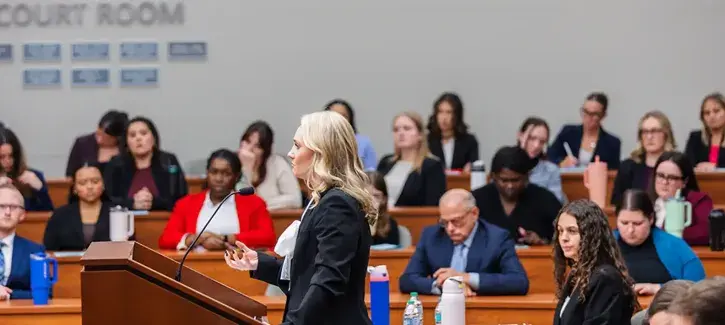
That philosophy is evident across the curriculum through trial competitions, moot court, arbitration, negotiation and mediation, clinics in which students represent real clients under faculty supervision and externships that place students in courts and firms before they graduate. Approximately 150 students participate in externships each year.
Jason Wendling, a JD candidate graduating in May 2026 and joining Dornan Law in Omaha, experienced the payoff of that model firsthand. His path to the firm ran directly through a faculty relationship. “Professor Lee Ellis had a connection with the firm and passed my name along,” he says. “From there, I had an interview and started as a law clerk. The faculty here aren’t just teaching you. They’re actively working on your behalf.”
Once at Dornan, the preparation quickly became tangible. When his supervising attorney asked whether he had experience with expert witnesses, Wendling was ready. “I told them I took a whole class on scientific evidence. My boss said, great, you’re working with our expert then.” When a court of appeals argument came up, the same confidence carried him through. “My boss asked if I’d ever argued before a court. I told him I’d done it at school. He said, all right, let’s do it.”
Bergstorm shares a similar experience. After earning her senior certification, she was scheduled to argue a motion to dismiss — which she wrote — before a trial court, while still a student. “I’ve already seen the impact of what I’ve learned,” she says. “Attorneys at the firm come to me now on things like arbitration because they know the background I’ve built. That trust is something I feel like I carry into every room.”
In both cases, the employers didn’t hand over responsibility by accident. They recognized what their training produced and responded to it.
A return that compounds over time
A law degree from Creighton is not a transaction. It does not conclude when the diploma is handed over or when the bar results arrive. The alumni who guest lecture, the partners who answer emails, the judges who remember names — they are the return on investment that no ranking captures and no tuition comparison conveys.
“You know your students,” she says. “We know them by name, we know what they do, we know where they go, what they care about. That's not true of every law school. And that matters not just while you’re here, but for the rest of your career.”
The students who walk into Creighton Law arrive with goals, questions and often, real anxiety about what the next three years will cost them. What they find is a school that takes all three seriously. The cost is transparent. The questions are answered by people who know their names. And the ambitions to pass the bar, get the right job and build a meaningful career — become the institution's ambition as well.
That is not a feature of the program. It is the program.