Early hands-on clinical experience
Students begin clinical training earlier than many programs, building confidence and real-world skills from the start.


At Creighton University College of Nursing, students gain more than technical training. They build confidence through early clinical experiences, learn alongside other healthcare professionals and develop the judgment and compassion today’s healthcare environments demand.
That commitment to excellence recently earned national recognition. The National League for Nursing named Creighton a Center of Excellence in Nursing Education, making it the first institution in Nebraska to receive the designation. The honor recognizes Creighton’s strength in academic quality, student support and preparing graduates to deliver compassionate, equitable care in communities across the country and around the world.
Creighton stands out among top nursing programs because it combines rigorous academics with real-world healthcare training and meaningful faculty mentorship. Students benefit from:
Students begin clinical training earlier than many programs, building confidence and real-world skills from the start.
Students practice in high-fidelity simulation labs that replicate real patient scenarios and strengthen clinical judgment.
Students train alongside peers in medicine, pharmacy and other health professions, reflecting real care teams.
Students are prepared to care for patients’ physical, emotional and ethical needs through a compassionate, patient-centered approach.
Graduates consistently achieve strong licensure pass rates and successful career outcomes after graduation.
Graduates consistently achieve strong licensure pass rates and successful career outcomes after graduation.
Together, these indicators reflect a program that delivers measurable results, not just academic theory. Creighton graduates enter the workforce ready to lead with skill, confidence and compassion.
Creighton’s nursing programs stand out in five key ways:
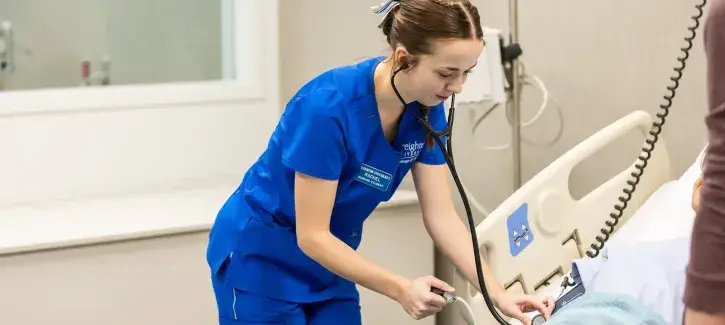
Beginning sophomore year, Creighton nursing students begin practicing core skills such as vital signs monitoring, developing confidence and real-world skills earlier than many programs.
Students complete clinical rotations at respected healthcare institutions across Omaha and Phoenix, caring for diverse patient populations in hospitals, specialty clinics and community settings.
Creighton also guarantees a senior-year preceptorship, giving students 244 hours of immersive hands-on experience. This is among the highest number of preceptorship hours of any nursing programs in the nation. Traditional Bachelor of Science in Nursing students complete more than 1,000 clinical hours before graduation, while accelerated students complete more than 900 hours across six specialty areas.
Students strengthen clinical judgment and decision-making skills in advanced simulation centers on Creighton’s Omana and Phoenix campuses.
At the CL and Rachel Werner Center for Health Sciences Education and the Creighton University Health Sciences Campus – Phoenix, high-fidelity simulations and virtual reality technology allow students to practice responding to realistic patient scenarios before entering clinical settings.
These immersive experiences help students build confidence and clinical judgment while refining communication, teamwork and critical thinking skills.
Healthcare today depends on collaboration. Creighton nursing students learn in team-based environments alongside students studying medicine, pharmacy and other health professions.
This interprofessional approach mirrors modern healthcare systems and helps students understand how collaborative care improves patient outcomes, communication and efficiency.
Learning across disciplines also reflects one of Creighton’s core strengths: preparing students to succeed in complex professional environments through mentorship, teamwork and practical experience.
Creighton’s approach to nursing education is grounded in cura personalis, the Jesuit tradition of caring for the whole person. Students are challenged to think deeply about the kind of healthcare professionals they want to become and the impact they hope to make in their communities.
Faculty encourage students to consider not only physical health, but also the emotional, spiritual and ethical dimensions of patient care. That emphasis reflects Creighton’s Jesuit, Catholic commitment to forming compassionate professionals who lead with empathy, integrity and purpose.
Creighton nursing graduates consistently achieve strong outcomes after graduation.
The College of Nursing reports a 96.2% NCLEX pass rate from 2022-2024 for the traditional BSN program. Over a five-year period from 2020-2024, the pass rate was 93%. The college also reports a 98.8% nurse practitioner certification pass rate average from 2020-2024.
Career outcomes are equally strong. According to the First Destination Survey for the Class of 2025, 100% of graduates reported successful outcomes within six months of graduation. Among bachelor’s degree graduates, 87% were employed and 13% continued into graduate or professional programs across 24 states.
Creighton offers nursing programs at both its Omaha and Phoenix campuses, providing students experience across two distinct healthcare environments.
Omaha, Nebraska: Community and regional healthcare systems
Through Creighton’s primary clinical partner, CHI Health, students train alongside experienced healthcare professionals in hospitals, specialty units and community-based settings.
These experiences expose students to high-acuity care environments while strengthening teamwork and patient communication skills.
Phoenix, Arizona: Large-scale healthcare systems
At the Creighton University Health Sciences Campus – Phoenix, students benefit from partnerships through the Creighton University Arizona Health Education Alliance and healthcare organizations across the region.
Students gain access to diverse clinical experiences, advanced facilities, collaborative research opportunities and nationally respected faculty mentors.
Together, Creighton’s dual-campus model provides broader clinical exposure than many single-location nursing programs.
According to the U.S. Bureau of Labor Statistics, employment for registered nurses is projected to grow 5% from 2024 to 2034 as healthcare needs continue to expand. Employers increasingly seek nurses who combine technical expertise with communication, adaptability and compassion. Creighton graduates are known for arriving workforce-ready because they have already trained in fast-paced clinical environments and collaborative healthcare teams.
Healthcare employers consistently value Creighton graduates for being:
Yes, Creighton may be an excellent fit for students who want:
Creighton University’s nursing program stands out because it blends clinical excellence, real-world training and a commitment to compassionate care.
For students searching for the best nursing schools, Creighton offers a balanced approach that prepares graduates not just to pass exams, but to succeed in modern healthcare environments.