

Student Research Programs
Summer Research Institute
In a nation of changing demographics, it is important to maintain a representative balance of population and workforce. However, some minority groups are severely underrepresented in sciences and healthcare occupations, undermining the nation's strengths as a leader in science, health and technological advances. It is becoming increasingly clear that as population demographics move toward icreased diversity, the future health and prosperity of the United States will depend on equitable representation and participation in science, health and technological occupations. Learn more about the Summer Research Institute programs below.
Undergraduate Biomedical Research Program
The CPHHE Undergraduate Biomedical Research Program enhances college science education and increases the number of underrepresented minority students who are interested and qualified to pursue careers in biomedical sciences through conducting kinesthetic laboratory research in various biomedical fields. Students are paired with Creighton University faculty and researchers to conduct ongoing research under the supervision of a faculty mentor.
Program Description
- Program Duration: Eight (8) weeks
- Program Timeline: June 1–July 23, 2026
- Monetary Stipend: $2,000
- Continuous Education: Weekly Friday Health Disparities Training Seminars
- Presentation: Colloquium (Oral and Poster Presentations) on July 23, 2026
- Career Field/Social Outings: College World Series Home Run Derby, Omaha Jazz on the Green, Juneteenth Parade, and any other STEM activities on-going in Omaha will be considered.
- Mentor Research Focus Areas: Cancer Biology, Cell Biology, Neuroscience, Biochemistry, Pharmacology, Exercise Science and Public Health
Eligibility
Students are required to have the following qualifications to participate:
- A student must have a 3.0 or better grade average
- Current sophomore, junior or senior college academic standing at time of application (Spring 2026)
- Copy of college academic transcripts (unofficial or official) Note: Do not send a link to us to retrieve your transcripts, i.e. Clearinghouse, etc. Download your own transcripts and attach your transcripts in the program application
- Two Letters of Recommendation (Recommenders will be sent a separate link to submit)
- If you have any questions about requirements or documents, please contact us at AbbieDeng@creighton.edu.
Important Dates
- Applications Open: November 17, 2025 (Monday)
- Application Closing Date: March 2, 2026 (Monday)
- Notice of Interview: March 11, 2026 (Wednesday)
- Interviews: March 16, 2026 (Monday) – March 20, 2026 (Friday)
- Acceptance Notice: April 3, 2026 (Friday)
- SRI Program Begins: June 1, 2026 (Monday)
- SRI Colloquium and End: July 23, 2026 (Thursday)
Information Session:
- Check back later
High School Community-Based Research Program
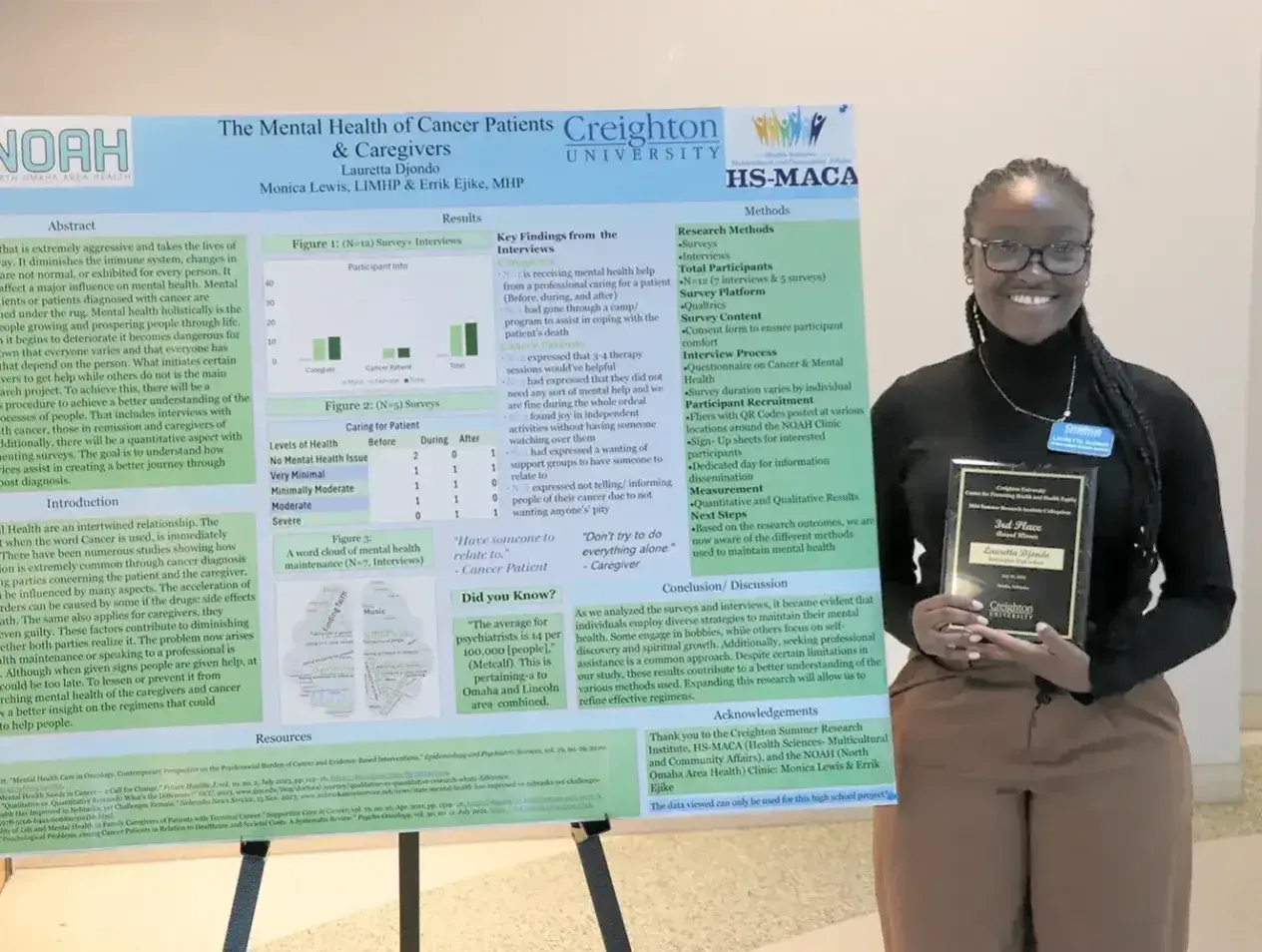
The purpose of the Summer High School Community-Based Research Program is to provide hands-on, community-based research among underrepresented minority groups. At the end of the program, the students will be able to enhance their high school education and build health disparities knowledge. Students work at a community-based organization for six weeks. The students will receive training in health disparities and perform research projects in their community. Students will work with their community site to learn about issues in their neighborhood by learning research methods, developing surveys, examining data, doing community mapping, and conducting interviews resulting in policy recommendations.
Program Description
- Program Duration: Six (6) weeks
- Program Timeline: June 1 – July 10, 2026
- Monetary Stipend: $1,200
- Presentation: Colloquium (Oral Presentations) on July 23, 2026
- Career Field/Social Outings: College World Series Home Run Derby, Omaha Jazz on the Green, Juneteenth Parade, and any other STEM activities ongoing in Omaha will be considered.
Eligibility
- Must have a 2.5 or better grade point average
- Sophomore, junior or senior academic standing at time of application (Spring 2025)
- Copy of academic transcripts (unofficial or official)
- Two (2) letters of recommendation
- Living arrangements within the Omaha area for program duration - We can provide on-campus housing only for students during this program
Important Dates
- Applications Open: November 17, 2025 (Monday)
- Application Closing Date: March 2, 2026 (Monday)
- Notice of Interview: March 11, 2026 (Wednesday)
- Interviews: March 23, 2026 (Monday) – March 27, 2026 (Friday)
- Acceptance Notice: April 3, 2026 (Friday)
- SRI Program Begins: June 1, 2026 (Monday)
- SRI Program Ends: July 10, 2026 (Friday)
- SRI Colloquium: July 23, 2026 (Thursday)
Engaging African American Students in STEM Education (EASE) Summer Immersion Challenge
This program is not currently accepting applications. Check back for future opportunities.
This program, hosted jointly by Creighton University (Omaha, Nebraska) and Hampton University (Hampton, Virginia), is for rising African American 9th-10th grader in Omaha Public Schools/Hampton City Schools. In this paid Summer Immersion Challenge, you will learn from experts in the fields of neuroscience, physics, chemistry, mathematics, and public health in topics related to infectious diseases and pandemics!
What to Expect
This Summer Immersion Challenge is focused on science, technology, engineering and mathematics (STEM) enrichment and scientific communication skills.
You will have an opportunity to learn directly from faculty members who conduct research in fields of neuroscience, physics, chemistry, and mathematics. You will then have a chance to develop social media material, such as TikTok videos, Buzzfeed articles, Instagram posts and blog posts, to communicate what you learned to a wider audience.
Faculty
Creighton University/Omaha Public Schools:
Dr. Eric Haas: Associate Professor of Chemistry
Dr. Andrew Ekpenyong: Assistant Professor of Physics
Dr. Shashank Dravid: Associate Professor of Pharmacology and Neuroscience
Hampton University/Hampton City Schools:
Dr. Peter Njoki: Associate Professor of Chemistry and Biochemistry
Dr. Francis Erebholo: Assistant Professor of Mathematics
Dr. Insu Hahn: Associate Professor of Chemistry and Biochemistry
Education/Cultural Awareness Specialist:
Dr. William Austin: Associate Professor of Teacher Education (University of Nebraska Omaha)
Eligibility
The EASE Summer Immersion Challenge is open to African American students entering grades 9 – 10, who demonstrate an interest in Science, Technology, Engineering and Mathematics (STEM). Space is limited to 10 students from Omaha Public Schools and 10 students from Hampton City Schools.
Application
The application process includes completing the application form, which consists of writing an essay demonstrating interest in STEM, obtaining a letter of recommendation, and providing other necessary information.
This program is not currently accepting applications. Check back for future opportunities.
Dr. Frank T. Peak Essay Competition
Essay topic options (write on one topic):
- Intersection of diabetes and technology, with a health equity and health disparities focus.
a. Discuss health equity issues in using technology for diabetes management. (For example, would enhanced technology improve or worsen health disparities, such as for United States populations with disadvantage.) Summarize key/ core access issues and solutions for different populations. - Telemedicine for diabetes management in rural communities.
a. Discuss the use of telemedicine in the management of diabetes in rural communities and the impact on health outcomes, including patient and family satisfaction, health equity and health disparity aspects. Optionally, also include health policy issues and/ or potential impacts on other chronic conditions. - Advancement in diabetes care using an interprofessional approach.
a. Discuss challenges and issues in team approaches, adding patient and family factors, with a health equity and health disparities focus.
The Dr. Frank T. Peak Health Disparities Essay Competition recognizes outstanding student research and scholarship that analyzes the intersections of public health, healthcare, and social sciences in order to promote health equity for ethnic/racial minorities and other populations with disadvantages.
Eligibility
To be eligible for the competition, a student must be currently enrolled in an accredited, academic undergraduate or graduate program in the U.S. and be able to present their essay remotely during the 2025 Addressing Health Disparities Seminar on April 26, 2025, in Omaha, Nebraska. The student must be the manuscript author. The paper must not be published, accepted or under consideration for publication at the time of submission.
Essay/Manuscript Instructions
Authors should follow the American Psychological Association (7th edition) guidelines throughout the essay. Details are as follows:
- Length should be 2,000 - 2,500 words, excluding title, abstract and references
- Use 1-inch margins
- The document should be double spaced and left justified
- Make the cover page a separate document with:
- Essay title
- Word count
- Full author contact information (email, phone number, mailing address)
- Institutional affiliation
- Degree program
- Degree candidacy
- Program director with contact information
- The abstract will need to be:
- Inserted during the application with no identifiers (name, school, etc.)
- Maximum of 500 words, single spaced and left adjusted with 1-inch margins
- State the essay’s proposed title and purpose. Summarize key points, core arguments and conclusions. Avoid merely listing topics to be discussed.
- Omit references, charts and pictures
- The essay should be a separate document that’s:
- De-identified
- Organized in the following format:
- Title and abstract (page 1)
- Body of essay (all sections labeled except introduction)
- Introduction, including essay purpose and strategy
- Literature review and critical analysis
- Discussion with core recommendations and reasoned defense
- Objections or counterarguments with responses
- Conclusion (restates purpose, summarizes key points, optionally suggests needs for future work)
All manuscripts must be received by the CPHHE business office via submission at https://blueq.co1.qualtrics.com/jfe/form/SV_2bC0ViitNzh1I5E by 11:59 p.m. CST March 17, 2025.
Only complete submissions that meet eligibility requirements and essay instructions, which are received by March 17, 2025, 11:59 p.m., will be considered.
Notification of results: April 3, 2025.
Review Criteria
Manuscripts are reviewed without author or institutional identification. The text should omit identifying information or obvious clues. All submissions will be reviewed anonymously by an independent panel on the basis of the following: Content relevance, significance, and development; organization and how well the structure meets criteria; clarity, grammar, punctuation, and spelling.
- 1st Place: $1000, online presentation at the 2025 Spring Addressing Health Disparities Seminar on Saturday, April 26, 2025. An abstract will be published in the seminar proceedings.
- 2nd Place: $500, an abstract will be published in the seminar proceedings.
- 3rd Place: $250, an abstract will be published in the seminar proceedings.
Dr. Frank T. Peak was a highly regarded Omaha community member dedicated to positive change in underserved communities, primarily North Omaha. Dr. Peak spent his life serving in an effort to eliminate health disparities and build trust between institutions and the communities that they serve. Whether through his early service as a member of the Omaha Chapter of the Black Panther Party or as an integral member of the Creighton University Medical Center as a community relations liaison, Dr. Peak exemplified great leadership and care for social justice through his work and efforts to better our Omaha communities.
