Creighton at the forefront of AI education for all undergraduates
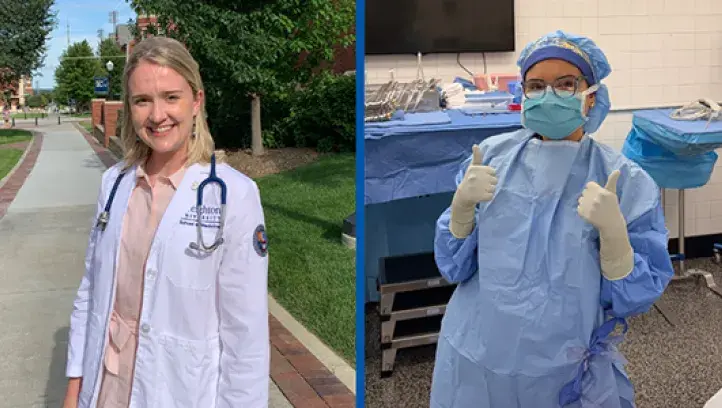
With more than 2 million people using ChatGPT every week for advice on health and wellness, according to the company, exercise science graduates must critically examine AI-generated recommendations to give their clients the best professional advice.
In exercise science, and across other disciplines, Creighton University is integrating AI learning outcomes across its undergraduate courses, with content tailored to students’ areas of study and future professions.
“The outcomes require students to demonstrate the effective use of generative AI, as well as analyze the ethical dimensions of its use,” said Guy McHendry, PhD, associate professor in the Department of Communication Studies and director of the Magis Core Curriculum at Creighton.

Magis Core: A universal experience
In 2013, Creighton adopted the Magis Core Curriculum, which focuses on developing communication, problem-solving, critical-thinking and ethical decision-making skills for all undergraduate students.
Students are required to take 35 credit hours of Magis Core classes over their four years at Creighton.
“The Magis Core reflects what a Jesuit education should be as a universal experience for all undergraduate students,” McHendry said.
“Technology has been part of Magis Core since its inception,” he added. “We were a leader then, and today’s AI outcomes are an extension of our obligation to help students think critically and prepare them to be ethical leaders in their fields.”
Creighton’s approach has not been overly prescriptive. While faculty receive training and guidance for incorporating AI into their curriculum, they are empowered to develop the content that resonates with their specific field of study.
Historical Hoaxes to Clinical Accountability
So, for instance, Creighton now offers a history course that uses AI to illustrate a historical hoax. Students learn about AI-image generating tools and then create “evidence” (AI-generated photos, archival material and other documents) that would support “truth” of the hoax, which they share in a classroom presentation. Through this exercise, students explore the tools and critical-thinking skills necessary to effectively evaluate a historical source.
“It’s a good exercise because they are working with the technology, they are getting at some of the ethically dicey stuff that it can do, and they are getting better at analyzing primary sources, which is a key element of history,” McHendry said.
In that exercise science course, students are asking AI to generate exercise prescriptions for hypothetical patients. The students then critically evaluate AI’s recommendations for accuracy and appropriateness, using peer-reviewed research to support or refute those suggestions.
In a communication studies course, students are examining AI in the context of other technologies across history (such as the printing press) and other forms of communication. For instance, what are the best communication terms to describe the interaction a user has with an LLM (large language model)?
In nursing, Creighton students are examining AI in terms of accountability in the clinical setting. What are the ethics, benefits and drawbacks of using AI in clinical decision-making? And who is responsible if there are errors? And what boundaries will students set for themselves in using generative AI in future professional tasks?
“So, we’re not just teaching students one way of using it, or one way of thinking about it,” McHendry said.
Reflecting Creighton’s Jesuit mission, values
He adds that Creighton is also working to use its Jesuit mission and values as a guiding approach to learning, working, leading and living in these rapidly advancing technological times – so that students ask the right questions that move humanity forward.
“Jesuit pedagogy really embraces the idea of discernment,” McHendry said. “And, so, we want our students to have this guide for how they should think about this. If we just give them a list of rules – what you can and can't do – and then the technology changes four years from now, we have done them a disservice.”
McHendry said there were thoughtful, probing and difficult discussions among the faculty, but the focus was always on what’s best for students.
“Faculty were willing to dig in and engage,” McHendry said. “They have been amazing to work with and recognize the need for this kind of student education.”
AI in classrooms beyond the core
While the Magis Core provides a foundation, faculty are exploring AI in other discipline-specific ways across campus, perhaps nowhere more notably than in the Heider College of Business and its Department of Business Intelligence and Analytics (BIA), where AI is featured in classroom discussions, assignments and projects.
Anton Ames, MBA, a BIA instructor, challenges his students to explore how AI can be a “teammate,” along with other organizational functions like business analysts and project leads, to make information systems more effective and efficient.
“I imagine in the future, it will be something like C-3PO sitting at the table,” Ames said with a laugh, referring to the Star Wars character. “We’re not there yet, but it’s just another resource that can offer insight and challenge our thinking.”
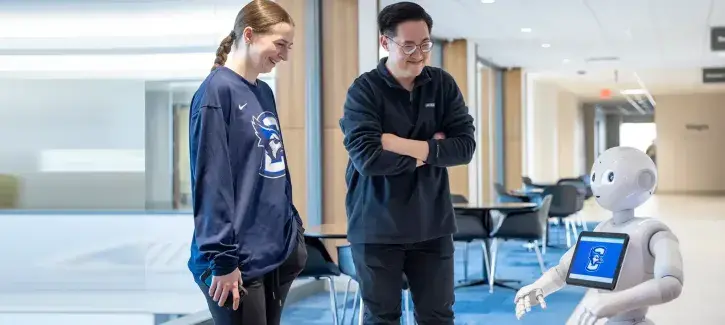
Natalie Gerhart, PhD, associate professor and BIA chair, and Greg Dyche, MBA, BIA instructor, are collaborating with a faculty colleague to use AI to help illustrate a crisis scenario in her organizational leadership class. They programmed one of the college’s social humanoid robots (named Pepper) to play a part in the experience, allowing students to ask questions and receive feedback in real time.
“It’s the same goal we’ve always had in education; it’s critical thinking,” Gerhart said. “It’s being good decision-makers, being life-long learners. We really don’t know what jobs will exist in five years. So, our students being adaptable and continuing to learn throughout their careers becomes exponentially important.”