Creighton student named 2026 Goldwater Scholar for AI research

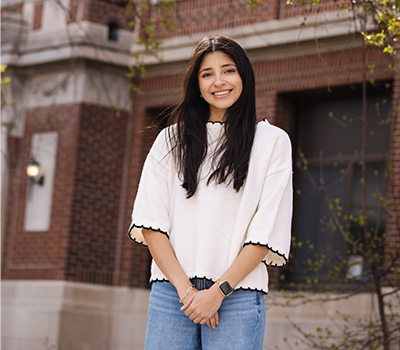
For Creighton University student Sara Avila, research is a way to advance technology and expand access, reduce inequities and create opportunities for others.
That commitment has earned Avila one of the nation’s most prestigious undergraduate honors: the Barry Goldwater Scholarship.
Established by Congress in 1986, the scholarship recognizes students with exceptional promise in natural sciences, mathematics and engineering who intend to pursue research careers. Avila, a junior triple majoring in computer science, data science and Spanish and Hispanic studies, is among 454 students selected nationwide from an estimated pool of more than 5,000 applicants.
“Creighton has provided me with countless opportunities...being part of an environment that values collaboration, curiosity and innovation has encouraged me to explore interdisciplinary research and connect my technical interests with real-world needs,” Avila says.
That emphasis on understanding people’s backgrounds—and advancing innovation that reflects the individuals it aims to support—makes recognition like the Goldwater Scholarship especially meaningful.
“Being named a Goldwater Scholar is an incredible honor that recognizes my passion and dedication to research, reinforces my commitment to a career in computer science and motivates me to continue growing as a researcher while contributing meaningful, impactful work,” says Avila.
AI Research for Social Impact
Avila’s work combines artificial intelligence and social impact, spanning natural language processing and computer vision, with a focus on building systems that are both technically strong and accessible.
She has contributed to several projects that use AI to advance equity and inclusivity. In one project, she helped develop an offline chatbot that analyzes medical school personal statements and provides feedback based on a rubric created by Creighton’s English Department.
In another, Avila worked as part of a team to train an object detection model to identify and count cochlear hair cells in microscopic images, supporting earlier and more accurate detection of hearing loss.
In an independent project, Avila analyzed “trace data”—records of interactions on GitHub, a software development program—to examine whether patterns in developer activity can help predict whether newcomers remain engaged in or abandon projects. Her research also explores the social barriers new contributors face and how these communities can improve inclusion.
That interdisciplinary approach stood out to the faculty who reviewed her application. “Sara Avila impressed the Creighton Goldwater committee with the creative ways that she uses computer science for positive social impact,” says Erin Gross, PhD, professor in the Department of Chemistry and Biochemistry and Creighton’s Goldwater representative for the past 10 years. “Sara embodies all the characteristics of a Goldwater Scholar.”
For Avila, the true measure of her work lies in its impact.
Simply put, Avila uses AI to improve how people learn, communicate and access information, especially in spaces where resources are limited.
Pursuing a Career in Computer Science
Following graduation, Avila plans to pursue a PhD in computer science and continue advancing AI research. She hopes her work will help shape technologies that empower individuals, rather than reinforce existing barriers.
“I hope my work contributes to building technology that expands access to opportunities, particularly in education and research, for people who may not have access to traditional support systems,” she says. “Ultimately, I aim to create work that not only advances the field of computer science, but also makes people feel more capable, included and supported in pursuing their goals.”
With that goal in mind, Avila also hopes to teach AI fundamentals and applications to the next generation of college students.
That vision is already evident in her work, says her mentor, Faith Kurtyka, PhD. “Sara is poised, professional and working at a very high level of research. I’m excited for the ways this scholarship will help her continue to grow as a scholar and leader in her field.”
Research Mentorship at Creighton
Avila credits part of her growth as a researcher to the mentorship she has received at Creighton.
“I am extremely grateful to Steven Fernandes, PhD, Kevin Lumbard, PhD, and Faith Kurtyka, PhD, for their guidance, support and willingness to invest in my development,” she says. “Through their mentorship, I’ve learned how to approach complex problems, communicate my ideas effectively and pursue research with both rigor and purpose.”
Kurtyka notes that mentorship is central to the research experience. “Mentorship is important in research because students often have fascinating questions on their own; a mentor can help guide them toward answers,” she says.
Lumbard follows this line of thinking: “Strong mentorship supports the development of an independent research identity and confidence, which are essential for students who wish to pursue a research career.”
That emphasis on advising, mentorship and undergraduate research is part of what continues to distinguish Creighton nationally, Gross says.
“Creighton attracts high-achieving students with interests in conducting undergraduate research,” she adds. “The fact that Creighton students have been so successful in obtaining Goldwater scholarships demonstrates not only the academic strength of our students but also both university and faculty commitment to the success of students in research.”
Creighton has made a significant investment in undergraduate research through the Center for Undergraduate Research and Scholarship (CURAS), Gross explains, providing students “access to research in all areas (science, social science, humanities, etc.) as well as the health sciences.” Students also gain access to summer scholarship programs and faculty-supported research grants.
Additionally, some students even get the opportunity to travel nationally and internationally to share their research at prestigious conferences.
“Sara traveled to London and presented our research at FICTA 2025, where she won the Best Paper Award,” Fernandes says, adding that she also presented at ICCV 2025 in Hawaii and NeurIPS 2024 in Vancouver. “For an undergraduate to be presenting at venues like NeurIPS and ICCV is remarkable.”
Creighton's Tradition of Goldwater Scholars
With Avila’s selection, Creighton continues its long-standing success as a top two Goldwater Scholar-producing Catholic university, alongside Notre Dame. Over the past two decades, 34 Creighton students have earned this prestigious recognition.
For Avila, that legacy is both an honor and an inspiration.
As she advances in her research, she remains committed to creating technology that pushes innovation forward and makes a meaningful difference in people’s lives.