Jesuit educators deepen leadership and mission through Creighton’s EdD program
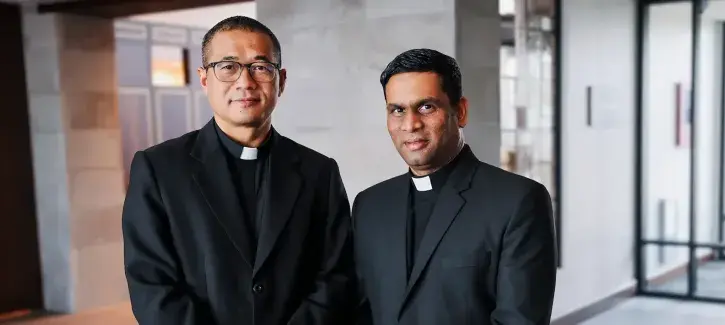
For Jesuits Rev. George Meze, SJ, and Rev. Elvin Cardoso, SJ, education is not simply a profession. It is a vocation rooted in Ignatian spirituality, service and the pursuit of justice. As doctoral students in Creighton University’s online Doctoral Program in Interdisciplinary Leadership, both men are sharpening their practice as educators while reflecting deeply on what mission-aligned leadership looks like in today’s classrooms and communities.
Creighton’s EdD program, designed for working professionals and mission-driven leaders, emphasizes reflective practice, rigorous scholarship and applied research through a dissertation in practice. For Fr. Meze and Fr. Cardoso, the program offers both academic formation and spiritual resonance.
A vocation shaped through teaching and service
Fr. Meze traces his call to education back to his teenage years, when a formative experience teaching in a remote Jesuit mission in Nagaland, India, changed the trajectory of his life.
“I am not sure how successful I was, but the experience was transformative,” Meze recalls. “It sparked my passion for teaching mathematics among Indigenous communities. It was there that I decided to become a Jesuit.”
Before coming to Creighton, Fr. Meze spent nearly a decade working with marginalized Indigenous communities in Northeast India. He describes that work not as sacrifice but as privilege.
“Those communities taught me humanity, love and generosity,” he says. “Despite scarce resources, their love shaped my conscience and showed me the meaning of serving in freedom.”
For Fr. Cardoso, the seeds of his vocation were planted earlier, during his own education at Loyola High School in Goa, India.
“They were not just excellent teachers,” Cardoso says of the Jesuits who taught him. “They became mentors, companions on the journey and gentle guides who formed us through their example.”
Fr. Cardoso credits the Jesuits with shaping how he understands education as accompaniment and formation.
“They walked with us, listened to us and encouraged us to see God in the everyday moments of study, friendships, successes and failures,” he explains. “I chose to join the Jesuits hoping to offer others what they had given me.”
Education rooted in justice and reflection
Both Jesuits view education as a powerful tool for justice and transformation. Fr. Meze’s research focuses on bilingual education in Northeast India, where language access is closely tied to dignity and opportunity.
“My research aligns closely with language justice,” he says. “It is about giving students the human opportunity to value their culture and social reality.”
He recalls helping establish a school in a remote village with minimal infrastructure. What made the difference, he says, was not the building but the commitment to teaching that honored the community and its language.
“Learning should not depend on resources,” Fr. Meze says. “What changed was the use of the mother tongue, supported by committed teachers and parents who believed in Jesuit education.”
Fr. Cardoso’s work is similarly grounded in justice and formation. As a former high school principal, he saw education as a way to help students engage critically with the world around them.
“I feel deeply responsible not only to teach what is in the books, but to help students look beyond the pages,” he says. “I want them to recognize how injustice takes root but also to believe that they can be agents of transformation.”
Leadership through Ignatian values
Both men say Creighton’s EdD program reflects Ignatian values in tangible ways. Fr. Meze points to the program’s emphasis on magis, service and concern for others.
“For me, development means becoming better than before,” he explains. “If it promotes the good of all without exploiting anyone, it reflects true spirituality.”
Fr. Cardoso describes the program as transformative, challenging traditional notions of leadership.
“I have come to appreciate that leadership extends beyond the leader-follower dynamic,” he says. “It includes coherent organizational vision, establishing structures that sustain that vision, recognizing patterns that facilitate its movement toward it and identifying forces that may undermine it.”
Courses such as Systems Thinking, Servant Leadership and Social Justice and Leadership have been particularly impactful for Fr. Cardoso.
“They were not just sources of information,” he says. “They are also catalysts for deeper engagement with our peers, invitations to personal reflection and opportunities to write on themes that truly mattered.”
Learning within community
The program’s online and hybrid structure has allowed both Jesuits to integrate doctoral studies with ministry and community life. Fr. Meze balances his coursework with his role in Campus Ministry, where he serves as a spiritual director and accompanies students through Ignatian reflection.
“Each student I interact with in this program has helped me see more in life,” Fr. Meze says. “My ministries and studies outcomes are often built on the reflection of these experiences.”
Fr. Cardoso says studying at Creighton has also shaped him through daily encounters beyond coursework. He pointed to the University’s attention to community life, from the careful planning of retreats and discernment programs to the generosity he has experienced within the Omaha Jesuit community.
“What I cherish most is the generosity of the community, both materially and spiritually,” he says.
As both continue their doctoral journeys, they see their work as part of a broader Jesuit mission. Long-term plans, Fr. Meze jokes, are often shaped by obedience.
But the commitment remains clear. “To do good to others,” he says. “That remains unquestioned.”
For Fr. Cardoso, the Universal Apostolic Preferences of the Society of Jesus provide daily guidance.
“They remind me why I am an educator,” he says. “And what kind of world I hope to help my students build.”