What the Winter Olympics reveal about peak performance and the inner life
As the world turns its attention to the Winter Olympics, viewers are drawn to more than speed, strength or spectacle. We watch athletes steady their breath before a final run, recover from devastating mistakes and perform under pressure that feels almost unimaginable. Again and again, they describe the same elusive experience: being in the zone.
But what’s really happening in those moments of peak performance?
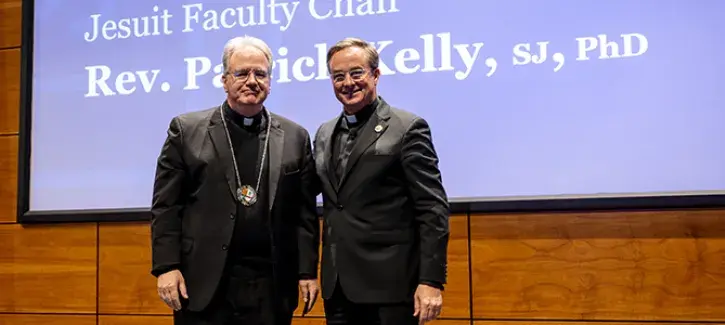
According to Rev. Patrick Kelly, SJ, PhD, a professor of theology at Creighton University and the Charles and Mary Heider Endowed Jesuit Faculty Chair, what elite Olympic athletes experience instinctively has deep roots in both psychology and spirituality—and it’s something students encounter more often than they might realize.
Another name for “the zone,” Fr. Kelly explains, is flow.
“When people are in flow, their attention is completely centered on what they’re doing,” Kelly says. “They’re not distracted by anything else. In fact, they’re not even thinking about themselves anymore.”
That loss of self-consciousness—what Fr. Kelly describes as a kind of ‘egolessness’—is one of the defining features of flow states. Athletes often report feeling fully immersed, connected to teammates or the rhythm of their sport, and part of something larger than themselves. Performance begins to feel effortless, even though it’s built on years of disciplined practice.
Why flow feels almost spiritual
What first drew Fr. Kelly to study flow wasn’t just its impact on performance, but how closely it resembled a concept from Jesuit spirituality.
“When I started reading about flow, it sounded very similar to the way Ignatius of Loyola describes spiritual consolation,” Fr. Kelly says.
In Ignatian spirituality, spiritual consolation is marked by joy, a sense of belonging to something greater and a gentle ease that comes not from avoiding effort, but from long-term discipline. Ignatius famously described it as “coming into your own house through an open door.”
“That same pattern shows up in athletics,” Fr. Kelly explains. “There’s effortlessness, but it’s preceded by discipline. You practice, you train, you fail, you grow—and over time, excellence begins to feel more natural.”
For Fr. Kelly, this connection underscores a core Jesuit belief: the human person is a unity of body, mind and spirit. What happens physically on the field inevitably shapes the inner life—and vice versa.
Rethinking success beyond winning
At the Olympic level, winning is the goal. Fr. Kelly is quick to acknowledge that. But research in sports psychology shows that when athletes become overly focused on outcomes, performance often suffers.
“Too much attention on results can actually pull a person out of the present moment,” he says. “And that undermines what they need to do to perform well.”
Some of the most successful coaches in sports understand this. Fr. Kelly points to leaders who emphasize process over outcome.
The same principle applies in the classroom.
“If a student is only focused on the grade, they might miss the intrinsic meaning of what they’re studying,” Fr. Kelly says. “Ironically, when students become genuinely interested and engaged, they tend to perform better anyway.”
What students can learn from Olympic athletes
While Olympic athletes perform on a global stage, Fr. Kelly emphasizes that flow isn’t reserved for elites. Even young children experience it naturally when they play being fully immersed, unselfconscious and present.
One simple practice Fr. Kelly often recommends to students before a test, presentation or performance is meditation.
By quietly paying attention to the breath, students can notice distractions, anxiety or fear as they arise and then let them go.
“If we’re not aware of that anxiety, it’s actually driving us,” Fr. Kelly says. “Meditation gives us more freedom to center our attention on what really matters.”
For people of faith, that practice may also involve inviting God’s presence into moments of preparation and performance. But at its core, the goal is the same: interior freedom.
The Olympics as a lesson in human flourishing
For Fr. Kelly, the deeper message of the Winter Olympics isn’t about medals—it’s about what sport reveals about being fully human.
“The Olympics remind us that we belong to one another,” he says. “They’re a powerful expression of our shared humanity, across cultures, nations and traditions.”
In that sense, sport becomes more than competition. It becomes a laboratory for character, humility, resilience and truth-telling, all qualities that sustain excellence not just in athletics, but in education and life.
The Olympics show us that peak performance isn’t just about training the body. It’s about forming the inner life. When attention, purpose and freedom come together, we don’t just compete better—we live better.