
1. Immediate Safety Concern
If someone’s safety is in immediate danger, call Public Safety's emergency number (402.280.2911) so that our officers can direct first responders to the emergent situation most effectively.


Hazing can take many forms, but at its core, it involves requiring or coercing an individual to participate in activities that are uncomfortable, demeaning, or harmful, or that are imposed on someone because of their membership in a particular group or organization. Such actions are inconsistent with Creighton University’s mission and values.
Hazing is prohibited in all student organizations, teams, and groups at Creighton, regardless of intent or tradition. If you or someone you know experiences or witnesses behavior that may constitute hazing, you are encouraged to report the concern. Reports may be made to the Student Leadership and Involvement Center, Community Standards and Student Conduct, or through other reporting channels outlined below so the university can respond appropriately.
Hazing is any intentional, knowing, or reckless act committed by a person, individually or with others, against another person in the course of initiation into, affiliation with, or maintenance of membership in a student organization that:
Hazing includes actions in connection with training, indoctrination, qualification for membership, functions or activities, or initiations conducted or sponsored by any student organization, athletic team, or group of students.
Hazing also includes any act or situation intended to produce or reasonably likely to produce unusual or unnecessary mental or physical discomfort, embarrassment, harassment, ridicule, or any risk of physical, mental, or emotional harm or injury.
The University reserves the right to interpret and apply this policy to student actions as deemed appropriate under the circumstances.
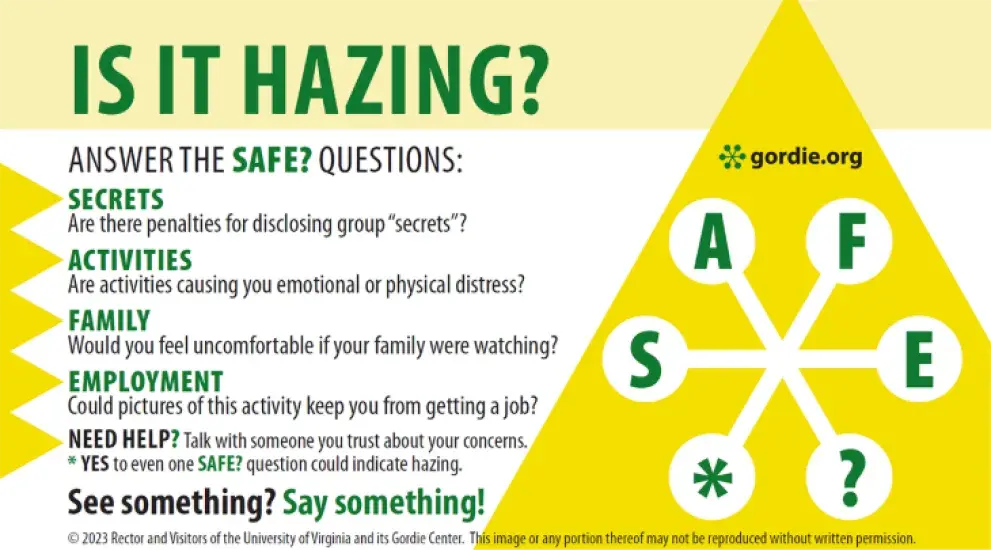
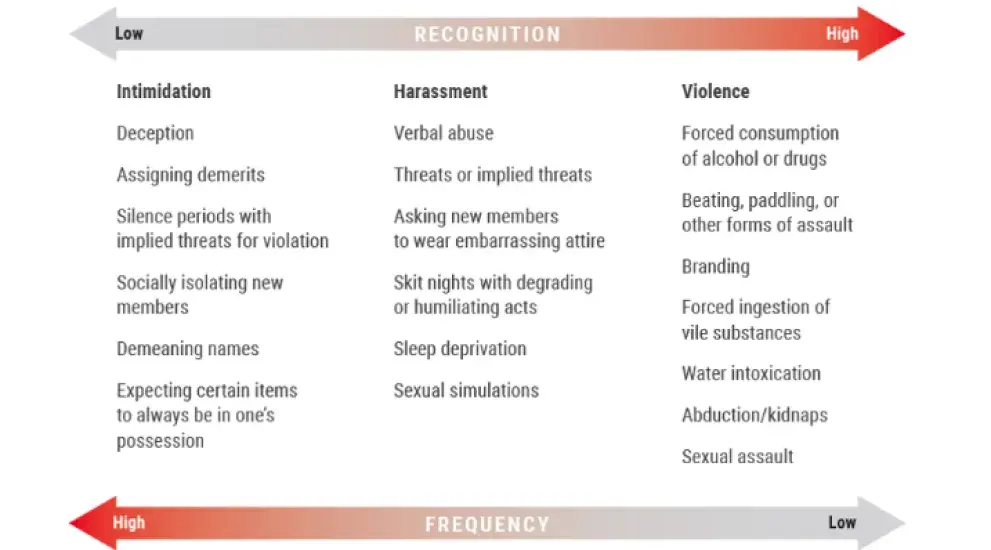
Hazing can happen in any student organization or group with a hierarchical or membership process, including academic clubs, athletic teams, fraternities and sororities, cultural groups, performing organizations, and informal student groups.
Hazing is contrary to the Creighton Student Credo and community values. It undermines individual dignity, safety, and the inclusive environment Creighton seeks to foster.
Creighton will impose serious disciplinary action on students or student organizations found responsible for hazing, which may include:
Hazing may include, but is not limited to, activities or situations that:
Hazing can happen in any student organization or group with a hierarchical or membership process, including academic clubs, athletic teams, fraternities and sororities, cultural groups, performing organizations, and informal student groups.
Hazing is contrary to the Creighton Student Credo and community values. It undermines individual dignity, safety, and the inclusive environment Creighton seeks to foster.
The University strictly prohibits hazing - in any form, at any time - including hazing in connection with training, indoctrination, qualification for membership, functions or activities, or initiations conducted or sponsored by any student organization, athletic team, or group of students. Hazing includes any action taken or situation created, whether on or off campus, intended to produce or which may foreseeably produce unusual or unnecessary mental or physical discomfort or pain, embarrassment, harassment, ridicule or risk of physical, mental or emotional harm or injury.
Hazing also includes any action or situation which is intended to be or which may foreseeably be morally, physically, emotionally or mentally degrading to any individual, or which unnecessarily exposes any individual to any risk of physical, mental or emotional harm, injury or distress beyond the risks encountered in ordinary daily life, or which is intended to intimidate or has the effect of intimidating any individual to unwillingly or reluctantly engage in any activity, or which unreasonably interferes with scholastic activities or pursuits of any individual.
As examples, hazing includes, but is not limited to, any conduct or method of initiation into or participation in any student organization, athletic team, or other student group which willfully or recklessly endangers the physical or mental health of any student or other person, including, but again not limited to: whipping, beating, or branding; forced, coerced or required calisthenics or physically exerting activities; exposure to weather or the elements; forced, coerced or required consumption of any food, liquor, beverage, drug or other substance; any brutal or cruel treatment; and any activity which subjects any student or other person to extreme mental stress, including any extended deprivation of sleep or rest or extended isolation.
The University fully reserves to University officials the authority to interpret this policy, and to apply the policy as so interpreted, to the actions of University students and organizations, as University officials in their discretion deem appropriate under the circumstances.
Serious disciplinary action will be imposed by the University upon any student or student organization, athletic team, or group of students found in violation of this policy, up to and including revocation of the charter of, and/or withdrawal of University privileges from, a student organization, athletic team or student group and suspension or dismissal from the University of individual students determined to have violated this policy.
Additionally, the State of Nebraska regards hazing as an illegal act. The Nebraska statute is defined here.
Nebraska Law: https://stophazing.org/policy/state-laws/nebraska/
§ 28-311.06. Hazing, defined; penalty
For purposes of this section and section 28-311.07a. Hazing shall mean any activity by which a person intentionally or recklessly endangers the physical or mental health or safety of an individual for the purpose of initiation into, admission into, affiliation with, or continued membership with any organization as defined in subdivision (1)(b) of this section. Such hazing activity shall include whipping, beating, branding, forced and prolonged calisthenics, prolonged exposure to the elements, forced consumption of any food, liquor, beverage, drug, or harmful substance not generally intended for human consumption, prolonged sleep deprivation, or any brutal treatment or the performance of any unlawful act which endangers the physical or mental health or safety of any person; and
b. Organization shall mean an organization of student members operating under the sanction of a postsecondary educational institution but shall not include the alumni organization or any corporation which owns the house or real estate of such organization.
Penalties for a conviction of hazing can include:
It shall be unlawful to commit the offense of hazing. Any person who commits the offense of hazing shall be guilty of a Class II misdemeanor.
Any organization as defined in subdivision (1)(b) of this section whose members commit the offense of hazing in violation of the provisions of this section shall be punished by a fine of not more than ten thousand dollars.
Creighton University is committed to creating a community where students build each other up — not engage in harmful or degrading activities. Hazing contradicts the Creighton Student Credo and Jesuit values of dignity, respect, and community. Awareness and education play a key role in preventing hazing before it ever occurs.
Creighton University takes a proactive approach to hazing prevention through required education and training for students, staff, and faculty. These efforts ensure that all members of the community understand what hazing is, how to prevent it, and how to respond if concerns arise.
Hazing education helps ensure a shared understanding of expectations across campus. These trainings focus on:
By embedding hazing education at multiple entry points into the Creighton community, the University works to prevent harm before it occurs and to support a culture of respect and belonging.
There are several ways to report hazing concerns at Creighton. Wherever possible, please include as much relevant detail as you can (e.g., who was involved, what happened, when and where it occurred, and any witnesses).
If someone’s safety is in immediate danger, call Public Safety's emergency number (402.280.2911) so that our officers can direct first responders to the emergent situation most effectively.
Use the Creighton Tell Someone online reporting form to submit concerns about hazing or other policy violations. This form is available to all students, faculty, staff, and campus community members. (Requires Creighton NetID login)
You may contact the Office of Community Standards and Student Conduct directly at (402) 280-2775. This office receives and reviews reports of hazing and can guide next steps in the misconduct process.
Student leaders or organization representatives can also report hazing concerns through the Student Leadership & Involvement Center.
If you are not ready to make a formal report but want to talk confidentially about your concerns, you may consider support resources that can help you think through next steps:
These resources do NOT automatically trigger a formal University investigation unless you choose to make a report.
Although Creighton encourages internal reporting, individuals can also report and receive support though external sources:
