AI isn’t taking your job. It’s rewriting the rules of work.
Artificial intelligence doesn’t usually announce its arrival with a grand entrance. It shows up quietly, embedded in workflows, speeding up decisions and changing what “entry level” means. By the time people realize what’s happening, the rules of work have already shifted.

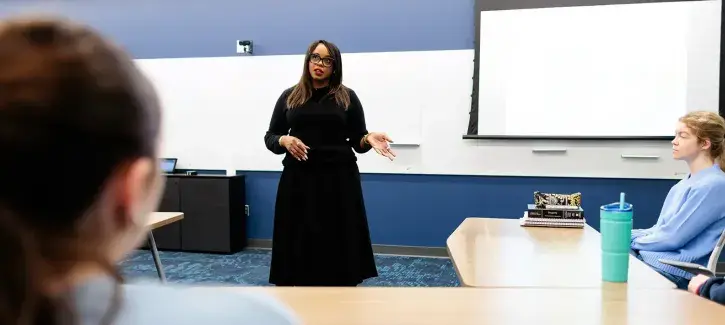
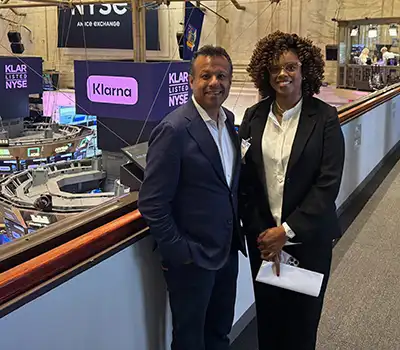
That shift is exactly what Regina Taylor, PhD, associate professor and chair of Marketing and Management at Creighton University’s Heider College of Business, has been addressing in national conversations on Today’s Marketplace. Speaking alongside leaders from Korn Ferry and IBM Consulting, Taylor offered a clear-eyed view of what AI means for students, professionals and the future of work.
Her message cuts through the noise. The real threat isn’t AI. It’s standing still while everything else moves.
“Students could be learning something in the classroom that’ll be obsolete within six months,” Taylor said. “If they are open to embracing change and open to learning the skills they’ll need continuously, then they’ll be successful no matter if it’s the first day on the job or the 4,400th.”
The jobs are changing, not disappearing
AI is already reshaping early-career roles. Routine tasks are being automated, expectations are rising and new responsibilities are emerging faster than job titles can keep up. Taylor doesn’t deny the disruption. She reframes it.
What employers need now are people who can adapt, think critically and make sense of complexity as technology evolves.
“At Creighton, we really think it’s important to help students understand that in order to be successful, not just after they graduate, but 40 years into their career, they need to embrace a growth mindset.”
That mindset matters because technology will keep changing. What lasts are the human skills that allow people to grow alongside it.
Why learning how to learn matters more than ever
Taylor is quick to point out that AI excels at speed and scale, but it falls short in places that matter most.
“AI is good at regurgitating. It’s good at packaging things that it already knows,” she said. “It’s not creative.”
Creativity, judgment and context are still human strengths. Employees who can question AI outputs, interpret results and apply insight are the ones who add real value. As AI tools become more powerful, those skills become more important, not less.
That reality changes how students need to be prepared, and it changes how universities think about teaching.
Teaching AI without losing human judgment
At Creighton, AI is treated neither as a shortcut nor as a threat. It’s treated as a tool students will be expected to use responsibly in the workplace. Taylor often draws a comparison to earlier technological shifts.
“Calculators were once thought of as cheating,” she said. “Now accountants and mathematicians use them every day.”
Through faculty development programs and partnerships with institutions like Harvard, Creighton instructors are learning how to integrate AI into assignments in meaningful ways. The goal isn’t to replace learning. It’s to deepen it.
“If we can help faculty understand that AI is not just a tool for cheating, but a tool students will need in the workplace, then students will be better for it.”
Bias, trust and the responsibility of using AI well
As AI becomes more embedded in hiring, decision-making and evaluation, Taylor emphasizes the importance of skepticism and ethics.
“AI is trained on material that’s already out there. If the models that are already out there are biased, then AI is going to be biased.” That’s why students are taught to look beyond polished outputs and understand how systems arrive at conclusions.
“They can’t take it for granted,” Taylor said. “They have to think critically about what they’re seeing.” This values-driven approach reinforces that AI decisions don’t exist in a vacuum. They affect people, communities and organizations in real ways.
Advice for anyone worried AI will replace them
Taylor’s advice applies across generations and career stages.
“The worst thing to do is nothing,” she said. “If it’s a way to advance the value you provide, not just learn new skills, but apply them, that’s going to be a positive.” AI does not eliminate the need for human judgment. It magnifies it for those willing to engage, learn and evolve.
And as Taylor’s national conversations show, Creighton faculty are not just reacting to changes in the workforce. They are helping shape how the next generation is prepared to lead within it.
Explore how Creighton’s Heider College of Business prepares students to be the best in business.