Strong job growth
Nurse practitioner roles are projected to grow about 40% by 2034, far faster than the average for all occupations (U.S. Bureau of Labor Statistics).


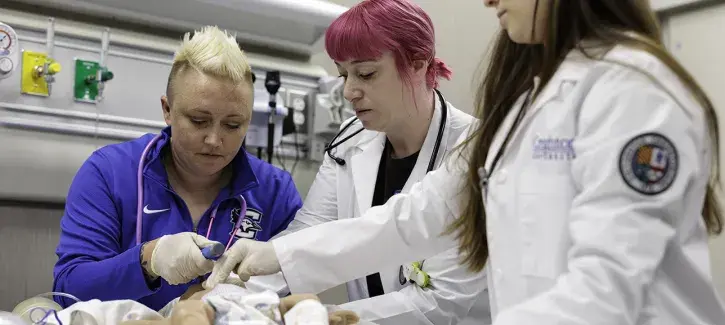
In neonatal intensive care units across the country, a quiet crisis is unfolding. While medical technology advances and survival rates for premature infants continue to improve, the specialized providers who care for these tiny patients are in critically short supply.
“From my perspective, one of the most urgent needs in our region is addressing the shortage of neonatal nurse practitioners,” says Melissa Buman, EdD, MSN, NE-BC, RNC-OB, C-EFM, director of Women and Children’s Services at Nebraska Medicine. “Many facilities are competing for a very limited pool of highly specialized providers.”
It’s a challenge that goes well beyond the Midwest. Neonatal nurse practitioners make up just 1% to 2% of all advanced practice registered nurses, yet the demand for their skills is surging. The numbers tell a compelling story about both urgent need and great opportunity for nurses interested in this specialization.
Creighton University’s Doctor of Nursing Practice (DNP) program trains neonatal nurse practitioners at the highest level, the terminal degree in advanced nursing practice. DNP students receive a comprehensive curriculum in leadership, population health, healthcare systems and finance, preparing them for greater impact in providing complex neonatal care.
The shortage doesn’t happen in a vacuum. Multiple factors are fueling the increasing demand for neonatal nurse practitioners, creating what some experts describe as a perfect storm.
“Several factors are driving this demand and growing need,” Buman explains. “Workforce aging and impending retirements. The complexity of neonatal care requires more advanced providers available at the bedside. Ongoing staffing shortages in healthcare in general further strain specialized roles like NNPs.”
Lisa Strasheim, MBA, MSN, APRN, NNP-BC, central region director for Women’s Service Line at CommonSpirit Health, has witnessed this evolution firsthand over her 40-year career in neonatal nursing. According to Strasheim, the neonatal nurse practitioner role expanded in the 1980s and 90s, largely because changes in medical residency programs reduced the amount of time residents spent in NICUs. “Now, these residents are my age or older, so everybody’s retiring.”
The competitive landscape reflects the urgency. Strasheim notes that some healthcare systems have increased sign-on bonuses to $50,000 for neonatal nurse practitioners. “NNPs and CRNAs are some of the highest paid Advanced Practice Providers, at least they are in our system,” she says.
Nurse practitioner roles are projected to grow about 40% by 2034, far faster than the average for all occupations (U.S. Bureau of Labor Statistics).
Neonatal nurse practitioners represent a small share of the NP workforce, and demand continues to outpace supply nationwide in NICUs.
Neonatal nurse practitioners typically earn $119,000–$140,000+ annually, depending on experience, setting and region.
States with strong demand and employment opportunities include California, Texas, New York, Florida and Ohio.
Doctoral-level training supports advanced clinical decision-making, leadership and readiness for complex neonatal care environments. Graduates have completed 1,200 clinical hours — double the clinical experience of many MSN programs.
For nurses considering advanced practice, the job outlook for neonatal nurse practitioners is exceptionally promising. The U.S. Bureau of Labor Statistics projects that employment of nurse practitioners will increase by about 35% over the next decade, significantly faster than the average for all occupations. Some analysts estimate that neonatal NP roles specifically could grow by 40% as NICU capacity and advanced neonatal care continue to expand.
Jessica M. Jones, DNP, APRN, NNP-BC, C-NNIC, a clinical assistant professor at Baylor University’s Louise Herrington School of Nursing and the lead for workforce research at the NNP association, provides a nationwide perspective on the shortage. “There is much greater demand than what we can meet right now,” Jones explains. “We are the only advanced practice registered nurses who are educated to care for babies at all gestational ages, which means if a 22-week baby is born at this hospital, we are educated and capable of caring for that patient.”
Joseph Tariman, PhD, MBA, RN, ANP-BC, FAAN, professor at Creighton University, emphasizes the importance of broader workforce development. “From my perspective, we need to meet the needs of the community. We need to offer programs that address that need,” he says. His niece, a neonatologist in New York, recently told him, “I couldn’t do my job without the neonatal nurse practitioners.”

Megan Falke, DNP, APRN, NNP-BC, assistant professor at Creighton University, describes the scope of practice that makes NNPs uniquely valuable. “I view our role as nurse practitioners through the lens of putting together puzzles and figuring out what pieces are missing and how we can make these patients feel better,” she says. “We take care of patients from birth to two years old, and we’re the only type of nurse practitioner that is certified to take care of premature babies. That allows us to have a lot of autonomy in our nursing practice.”
The diversity of practice settings reflects the wide range of roles. “There’s a variety of different workplaces we can work in,” Falke explains. “You can work in a nursery setting with newborn babies and postpartum moms. We have students who go out and work in rural places, like NICUs in Grand Island and Kearney, Nebraska. You can work in a children’s hospital caring for surgical patients and cardiac patients. Or an urban level three NICU with an active delivery service where patient needs are unpredictable.”
Jones emphasizes how NNPs connect different clinical worlds. “We really are a bridge between nursing and medicine. I know what it’s like to be at the bedside. I can start IVs, hang medications and work the IV pumps. But I also have training in pathophysiology, disease processes and embryology. I’m able to speak both languages.”
Buman emphasizes the impact on patient care: “NNPs’ consistent presence—24/7—ensures continuity of care and rapid clinical decision-making, which directly influences patient outcomes. They frequently lead or partner in quality improvement initiatives and research efforts that shape practice standards.”
The path to becoming a neonatal nurse practitioner requires strategic preparation. Programs typically require one to two years of neonatal intensive care nursing experience before admission, ensuring students bring significant bedside expertise to their advanced education.
At Creighton, the program structure is tailored specifically for employed nurses, balancing professional roles and academic demands. The program timeline allows students to set their own pace. “Almost all graduate nursing students are working. Most of them are working full-time,” Falke says. “The first one or two years are the core classes. Then, after that, they move into specialty role classes, and that’s when they start their clinical time. Students complete 12-hour clinical shifts each semester in addition to their regular job responsibilities.”
The program’s online format offers both flexibility and engaging learning experiences. “My students are all over the country,” Falke explains. “And so when we’re on Zoom together discussing a clinical problem, we are talking about how they would address it in Washington and how they would address it in Minnesota and how they might address it in Lincoln, Nebraska.”
This geographic diversity becomes a teaching advantage. “With all of the variety of neonatology groups that we work within, there are a couple of different ways that we could do something,” Falke notes. “One of my favorite parts is having conversations around what kinds of things they’re doing in the units that they’re either doing clinical in or working in, because there’s just so much variety and experience.”
Strasheim, who has supported many nurses in completing neonatal NP programs during her career, offers practical advice for those preparing. “I think getting a strong foundation of experience in the NICU is so important. The more experience you gain and the more cases you see, the better you can trust that gut feeling that you know something’s wrong. If you have a chance to be on a neonatal transport team, that’s just another step where you gain a lot of experience with advanced procedures and critical thinking skills.”
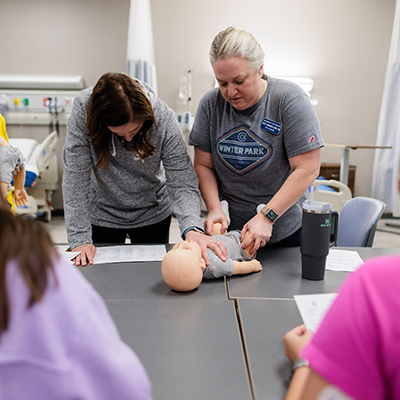
When Maria Schecher, DNP '26, was researching DNP programs, several factors attracted her to Creighton University. “What initially drew me to Creighton’s neonatal DNP program was cost, location, online courses and existing clinical contracts with the hospital where I currently work,” says Schecher, who plans to graduate in May. “Creighton was one of the nearest universities that offered a neonatal program. I found that Creighton’s doctorate program costs less than some master’s programs.”
The program’s flexibility proved essential. “The biggest factor was the fact that Creighton’s program was mainly online coursework. The program let me work full-time as a nurse and complete coursework on my own time,” she explains. “Even though this program is remote, the support a student gets makes me feel like I am in a classroom environment.”
The program focuses on scholarly work with lasting impact. “Students have an opportunity to implement really great scholarly projects in the units where they’re doing their preceptorships,” Falke notes. “When I was doing my doctoral work, I developed a perinatal hospice that still exists at Nebraska Medicine. These projects have broad impacts on positive patient outcomes.”
For Schecher, the faculty support has been life-changing. “I cannot say enough good things about the faculty at Creighton, especially Falke. The instructors understood this was a graduate-level program, and I was here because I wanted to be. They were willing to meet me where I was in my own life. They have different Plans of Study depending on how much workload the student can handle, and this can be adjusted as life changes.”
The integration of coursework, clinical practice and research components prepares Creighton graduates for the complex realities of advanced practice nursing. DNP students feel very prepared and confident as they transition to practice.
“There were many times when the coursework material aligned with what I would see during clinical, which enhanced the learning experience,” Schecher says. “The program has allowed me to dive into research with our Quality Improvement Projects, and I have grown a fondness for research because of it. Implementing the project has been eye-opening because it gave me a real perspective on what it takes to make or change processes and policies in an organizational setting.”
Falke emphasizes the importance of quality improvement work in building leadership skills. “It’s just such a unique approach to education. These doctoral projects really develop a mutually beneficial relationship with the student and the clinical site. They’re going to be career projects that have a lasting impact on patient care.”
Tariman emphasizes the University’s dedication to developing practice-ready graduates. “We need to be creative and innovative in creating pathways for advanced practice nurses,” he says. “Meeting workforce needs while maintaining educational excellence is critical to addressing healthcare shortages.”
Looking toward graduation, Schecher feels well-prepared for the challenges ahead. “Quality improvement is a continuous factor in healthcare, and having experience in leading one already makes me feel equipped to handle another. The program provided a comprehensive background of clinical information and practice, plus a view of big picture healthcare, including ethics, equity and justice.”
The financial investment in a DNP program yields strong returns. According to the Bureau of Labor Statistics, the median annual wage for nurse practitioners is about $132,050. Neonatal nurse practitioners typically earn between $123,000 and $136,000 annually, with some positions offering compensation of up to $178,000, depending on experience, geography and shift differential.
High-demand states for nurse practitioners include California, Florida, Texas, New York and Ohio, although opportunities are available across the country. In the Midwest, the shortage has created robust opportunities for new graduates, with several healthcare systems actively recruiting.
This demand creates a significant opportunity for newly graduated NNPs entering a market eager for their skills.
Beyond technical skills and clinical knowledge, specific personal qualities set successful neonatal nurse practitioners apart.
“Strong NNP candidates include those with strong critical thinking skills, clinical curiosity, adaptability and a commitment to lifelong learning,” Buman says. “For new graduates, individuals who demonstrate solid foundational neonatal knowledge, emotional resilience, eagerness to grow and the ability to function well within a collaborative team are incredibly helpful.”
Falke emphasizes attention to detail and advocacy. Neonatal nurse practitioners who are successful have great attention to detail. They’re really wonderful advocates for families and babies. There’s a lot of advocacy that goes on throughout the healthcare system as families navigate it almost every single day in the NICU.”
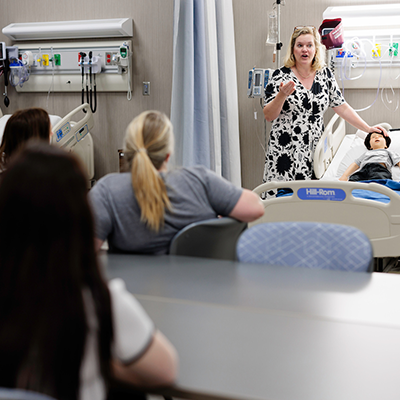
The convergence of workforce shortages, the expanding scope of practice and the increasing complexity of neonatal care create unprecedented opportunities for nurses considering this specialization.
“My advice is simple: If you feel called to pursue an advanced degree, such as an NNP, do it,” Buman says. “This is a deeply meaningful specialty with tremendous impact, and there is a significant need for dedicated neonatal providers in our region. Pursuing an NNP degree opens doors to a highly specialized, rewarding career where you can truly make a difference in patients’ lives.”
Jones sees the recruitment challenge as an opportunity for the field to grow. “We’ve got to find ways to bring more people to doing what we do. One of the things that we love to tell undergraduate nurses is just how much neonatal intensive care is a world that a lot of people don’t even know about.”
For healthcare systems, recruiting and developing neonatal nurse practitioners has become a strategic priority. “We love to grow our own,” Strasheim says. “We’ve sent a lot of people through the Creighton program — nurses who have shown great promise and have interest and want to grow in their career.”
Schecher reflects on how the program has prepared her for advanced practice. “The coursework and clinical practice provided a foundation in my professional development, and the research components provided me with the tools to keep evolving as a future nurse practitioner.”
Programs like Creighton’s play a vital role in addressing the workforce shortage while upholding the high standards essential to neonatal care. For nurses passionate about making a difference in the lives of the most vulnerable patients, the path forward has never been more straightforward or more necessary.