Artificial intelligence (AI) is changing how people apply for jobs, prepare for interviews and work across industries. For college students, that can create a lot of questions: Which AI skills do employers expect? How much AI use is too much? And how can students prepare when the technology keeps changing?
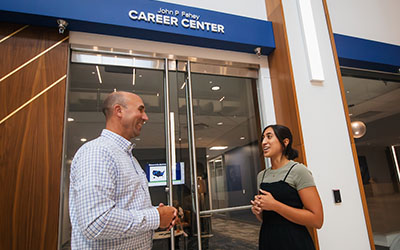
Seth Kleinwort, MS, assistant director of operations and outcomes in Creighton University’s John P. Fahey Career Center, offers a practical answer. Students do not need to master every AI tool. They need to use AI thoughtfully, understand the work behind it and explain their choices.
What AI skills do employers want?
Employers are still deciding how AI fits many roles. In job interviews, they may be less interested in technical expertise than in whether a candidate can use AI to solve a real problem.
Because expectations vary by industry and employer, there is no single set of AI skills every student needs. Curiosity and adaptability can be just as important as experience with a specific platform. Employers want to see that students can apply new technology to the work in front of them.
A student might describe how AI helped organize research, generate ideas, improve a process or reduce time spent on a repetitive task. The tool itself is less important than the student’s role and the result.
“They want to know that you can use the tool,” Kleinwort said. “But it’s a tool. How did that help you accomplish what you were trying to do?”
Getting a useful result takes more than entering a quick prompt. Students need to provide context, give clear direction and refine what they ask. Then they must check the response and decide what belongs in the final product. That process demonstrates both AI literacy and command of the underlying work.
How should students talk about AI in a job interview?
A strong answer goes beyond, “I used ChatGPT.” Students should prepare examples from classes, internships, campus jobs or projects and be ready to explain:
- What problem they were trying to solve
- Why they chose to use AI
- How they guided, refined and checked the output
- What knowledge, decisions or creativity they contributed
- What improved because they used it
These details show employers more than familiarity with a platform. They show how a student thinks, makes decisions and takes responsibility for the final work.
Why judgment still matters in an AI-driven workplace
AI can make work faster, but it cannot replace a person’s understanding of the fundamentals.
Students still need to recognize inaccurate information, identify missing context and step in when a tool does not perform as expected.
That is especially important for résumés, cover letters, portfolios and coding samples. If an application is far beyond what a candidate can explain or demonstrate in an interview, an employer may question whether the work reflects the applicant’s actual skills.
“If the person in front of you does not seem like the person who applied, that’s a red flag,” Kleinwort said. “Which experience is true: the one in the room or the one on the paper?”