


Creighton student develops Examen app to support veterans with PTSD

For Creighton University student Katherine Pansegrau, research began with a question she had long considered: What role does suffering play in people's lives?
That question led her to an undergraduate research project exploring how a centuries-old Jesuit prayer practice could potentially support veterans and military personnel living with post-traumatic stress disorder (PTSD).
Through a Summer Undergraduate Research Fellowship (SURF) with the Kripke Center for the Study of Religion and Society, Pansegrau spent the summer helping develop a mobile app that guides users through the Ignatian Examen, a structured practice of reflection and prayer.
Working alongside faculty mentors Christopher Krall, SJ, PhD, and Steven Fernandes, PhD, associate professor of computer science, Pansegrau helped adapt the Examen for people experiencing PTSD and moral injury, with the goal of making the practice accessible to individuals of different religious backgrounds.
The project brings together Pansegrau's interests in medicine, research and faith while exploring a potential new approach to supporting veterans' mental health.
Exploring the connection between faith and healing
Pansegrau, a junior studying medical anthropology, discovered Fr. Krall's research through Creighton's CURAS research database in late 2025. Interested in research that extended beyond a traditional laboratory setting, she was drawn to the project's focus on suffering and its connection to neuroscience.
"Fr. Krall's research was originally framed to me through the CURAS research database as neuroscience research trying to understand the question of suffering," Pansegrau says. "This is what initially sparked my interest, as I have always questioned the role of suffering in life."
The project centers on the Ignatian Examen, a spiritual practice formalized by St. Ignatius of Loyola in the 16th century. Through five steps involving gratitude, prayer, reflection, forgiveness and renewal, the Examen encourages individuals to examine their experiences and look toward the future.
Fr. Krall, a Jesuit priest and reserve Navy chaplain with appointments in Creighton's theology and biological sciences departments, has seen the effects of PTSD and moral injury through his chaplaincy ministry. His research explores memory reconsolidation, a process through which previously formed memories may be modified when recalled, and whether the Examen could offer a structured way for individuals to process traumatic experiences.
"This study brings together my interdisciplinary areas of expertise with the important need of addressing the ravaging effects of PTSD and moral injury, which I have seen in my chaplaincy ministry," Fr. Krall says.
Bringing the Examen into a new setting
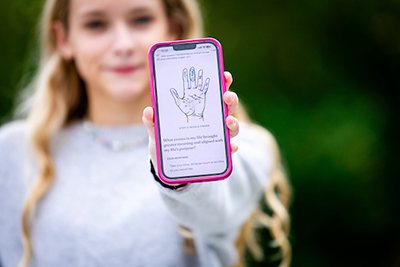
Throughout the summer, Pansegrau reviewed scientific literature and worked with Fr. Krall and Fernandes to adapt the Examen for individuals experiencing PTSD and moral injury, including those from different religious backgrounds. She helped develop guiding questions for the practice, assessed early app prototypes and learned about the approval process for research involving human participants.
The team now has a nearly completed prototype that researchers are using to identify and resolve issues before introducing it to study participants. They hope to begin with a small-scale study and eventually expand their research to include neurological measurements that could help evaluate the practice's potential effects.
For Pansegrau, the work offered a deeper understanding of the challenges veterans may face long after their military service, along with an opportunity to contribute to a project that connects her academic interests with her faith.
"I learned a lot about what veterans deal with long after their service," she says. "We are indebted to them, but I have only gained so much gratitude for them."
Research with a greater purpose
Beyond the app's development, the fellowship gave Pansegrau hands-on experience in interdisciplinary research and a chance to learn from Fr. Krall's background in Jesuit spirituality, neuroscience and military chaplaincy.
Fr. Krall praised her creativity and dedication throughout the summer, particularly her ability to analyze scientific research and consider how the Examen might be adapted to meet patients' needs. He sees the project as an example of Creighton's Jesuit mission in action, encouraging students to use their academic interests and talents in service to others.
"Being involved in SURF this summer has taught me about how I can make a difference from an academic perspective," Pansegrau says.
As she looks toward a career in medicine, Pansegrau hopes to carry that perspective into her work with future patients. Her experiences with healthcare, including those gained through her family and as a patient herself, have strengthened her commitment to compassionate care that considers patients' overall quality of life.
"I aspire to be a doctor who cares about the quality of life of patients," she says. "Although I do not fully understand the struggles that veterans deal with, I want to help them live fulfilling lives after how much they sacrifice for us."


