


IPH Hosts Dinner for Students, Symposium Keynote Speakers
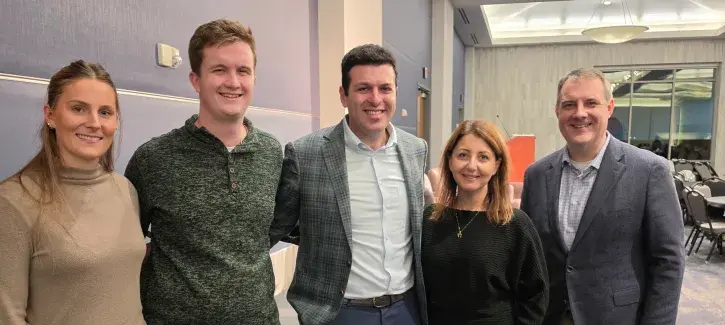
About 70 Creighton students gathered for dinner and an informal conversation and Q&A with Mandy Cohen, MD, MPH, pictured second from right, former director for the Centers for Disease Control and Prevention, and Jared Augenstein, MPH, pictured middle, senior managing director for Manatt Health on Nov. 4, the night before the University’s fourth annual Symposium on Population Health – Reimagining the Workforce for Population Health. The evening gave students the opportunity to engage directly with two national healthcare leaders in a relaxed setting.
Cohen and Augenstein began by sharing the paths that led them to their current work at Manatt Health, a consultancy based in Washington, D.C. Augenstein shared his background in global health and international development, his experience in Haiti following the 2010 earthquake and his transition into healthcare consulting and technology policy. Cohen reflected on her path from practicing physician to public servant, including discovering her strength in operations, her work at the Centers for Medicare and Medicaid Services, her leadership in North Carolina during the COVID-19 pandemic and her time as director of the CDC.
Several audience questions focused on career decisions and the uncertainty students often face when choosing a path. Both speakers encouraged students to try different experiences, seek advice from mentors and pay attention to the work that gives them energy. Cohen emphasized that careers rarely unfold in a straight line and that it is acceptable to make one choice, learn from it and make another.
“I think you try a lot of things and you figure out what you like and what resonates with you, and then that leads to the next thing and the next thing and the next thing, and it sort of builds organically,” Augenstein said. He shared that he chose Manatt over a position offering significantly more money because the people and culture felt like a better fit.
AI Oversight, Evaluation and Policies
The Q&A also explored artificial intelligence, healthcare payment, liability, privacy, sustainability and health disparities. The speakers described AI’s potential to reduce administrative burdens and give clinicians more time with patients, but also noted that it is not the answer to all problems.
Cohen and Augenstein emphasized that AI needs thoughtful oversight, independent evaluation and policies to ensure that it improves access, quality and population health rather than simply increasing revenue or accelerating the status quo or, worse, magnifying flawed data, weak systems and existing inequities.
As the evening concluded, Cohen and Augenstein encouraged students to prepare for a changing healthcare landscape by developing durable skills in communication, data analysis, leadership, teamwork and relationship-building. They urged students to remain curious, maintain a growth mindset and recognize that the human dimensions of healthcare — trust, empathy and connection — will become even more important as technology advances. The dinner offered a meaningful introduction to the symposium’s larger conversation and left students with both practical career advice and a sense of agency in shaping the future of healthcare.
“The human part is not the fluffy stuff. It’s the thing that allows you to drive change. It’s those trusting relationships,” Cohen said.
Medical students Katie Coughlin, pictured far left, and Seth Warner, piictured second left, served as moderators along with Scott Shipman, MD, MPH, executive director for the Institute for Population Health (IPH) and Nebraska Healthcare Collaborative Population Health Endowed Chair. The keynote session was sponsored by Crieghton’s three Institutes of Excellence – the IPH, the Kingfisher Institute for the Liberal Arts and Professions and the Institute for Adaptive Intelligence.