How connection can help prevent healthcare burnout
Understanding burnout in healthcare
Caregiver burnout has become one of the most pressing challenges facing healthcare practitioners. As Creighton Professor Tom Lenz, PharmD, explains, burnout is an emotional state rooted in chronic stress, most commonly marked by emotional exhaustion, depersonalization and a diminished sense of personal accomplishment. But these clinical markers only tell part of the story.
In real life, burnout feels like a loss of control—a sense of being overwhelmed by responsibilities that never seem to end. It can show up as emotional detachment, cynicism or the unsettling feeling of no longer caring about patients as deeply as before. It erodes caregiver well-being, compromises relationships and diminishes the quality of care. Even highly dedicated clinicians can find themselves struggling to maintain their presence and engagement.
How connection prevents burnout
For decades, clinicians were taught that connecting deeply with patients could lead to emotional exhaustion and burnout. Compassion was treated as a potential liability—an extra effort that might drain energy rather than restore it.
But modern research and practical experience tell a different story. “Connection is protective,” Lenz explains. “Burnout isn’t caused by caring too much; it’s caused by disconnection from people, from purpose, from meaning.”
Lenz nods to one study in particular that showed that practitioners who score high on compassion scales score low on burnout scales. “And the opposite was also true,” he says. “Those who scored low on compassion scales scored high on burnout scales. The ‘antidote to burnout,’ as some have called it, is not to escape, but rather to engage. This seems to be telling us something important about how we connect with others regardless of setting.”
This shift reframes compassion not as emotional labor but as a protective factor for caregiver well-being. Engaging authentically with patients can reignite purpose, strengthen resilience and counter isolation—all critical buffers against burnout.
Research shows the efficiency of compassion
Practitioners face significant demands on their time, administrative requirements and other pressures that can make the perception of maintaining consistent compassion challenging.
Despite these pressures, Lenz emphasizes that practitioners retain autonomy in how they conduct patient interactions. “Even in the busiest clinic, you still have a choice in how you connect with a patient,” he explains. “You can choose to lead with compassion, to be present, to notice what’s going on with the person in front of you. The system may limit time, but it does not limit your capacity for meaningful engagement.” To appreciate it more fully, it’s important to understand that compassion is about connection, not about taking on the suffering of others within yourself.
He continues that there are about a half dozen well-designed studies that look at how much time it actually takes for a clinician to offer compassion in a way that produces a statistically significant difference in outcomes, for example, helping a patient receiving a cancer diagnosis makes even a small movement on their anxiety.
That amount of time is forty seconds.
“I’m convinced that if your way of being as a provider is rooted in connection and compassion, then the number goes to zero,” Lenz adds. “Just being with a patient in your normal, everyday way of practicing already communicates compassion. You don’t have to add anything extra.”
This perspective tells us that burnout isn’t inevitable, but avoidable, mitigating the stresses of workload through conscious choices in patient interactions. The practitioner’s approach—whether rushed and detached or calm and connected—profoundly shapes both patient outcomes and clinician well-being.
Practicing compassion in the clinic
Lenz emphasizes that compassion is achievable in many ways, some of which are practiced by his third-year medical students in the clinic.
- Pause and breathe. Take three deep breaths before entering the patient’s room or reviewing the chart. This activates your parasympathetic nervous system, helping you arrive in a calm and present way patients can sense immediately.
- Use mindful posture. Square your shoulders to the patient and meet them at eye level. Your body language communicates attentiveness and presence as clearly as your words.
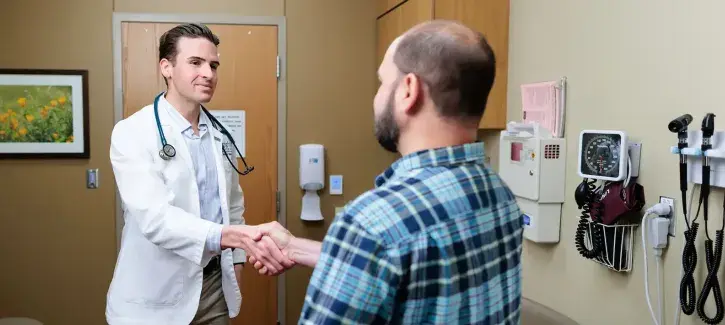
- Use thoughtful touch. When culturally and contextually appropriate, a handshake or a gentle hand on the shoulder conveys care and human connection.
- Speak inclusively. Use “we” and “our” to reinforce partnership, shared responsibility and collaboration in the patient’s care.
Patients will naturally perceive this compassionate care as authentic and attentive, and clinicians themselves will experience less stress and greater professional fulfillment.
Additional strategies that prevent burnout
Certain strategies, like mindfulness, meditation, contemplative practice and intentional physical activity, play an important role in regulating stress and preventing burnout. Lenz often tells learners that these habits don’t need to be complicated to be effective; in fact, their simplicity is what makes them sustainable.
He recalls a high-performing colleague who confided that loneliness was at the root of his emotional and physical struggles. “Stress becomes unrelenting when we lose connection with others, with nature, with our spirituality, with ourselves,” Lenz says. Over several months, they worked together to rebuild these connections through small but intentional practices: engaging socially, spending time outdoors, praying or reflecting, exercising, developing sleep strategies and meditating daily.
“When people begin meditating, they can briefly stop ruminating, are able to come back to the present moment and engage in the process of letting go,” he explains. Lenz recommends starting with Transcendental Meditation to trigger the relaxation response, gently putting aside distracting thoughts and eventually progressing toward contemplative practices that deepen awareness.
With these strategies, the colleague’s mindset gradually shifted from seeing only what was negative to noticing joy. None of the practices required much time, but the consistency and the compassion he extended to himself made all the difference. “These strategies are simple,” Lenz emphasizes, “but simple doesn’t mean easy. You just start small and keep returning to it.”
Continuing education as a tool to prevent burnout
Continuing education plays a pivotal role in shifting how clinicians think about compassion and connection. As Lenz explains, “without continuing education we may continue to practice with old assumptions that just are not supported by the literature.”
Creighton’s Integrative Care Certificate—a self-paced, 16-hour, CE-accredited program—helps participants reframe compassion to a core, trainable skill. Caregivers will learn contemporary research on compassion and connection and develop skills that address both system-level challenges and personal resilience.
Built around two badges of online coursework, the program equips learners to bring whole-person, evidence-informed care into their practice. Topics include mind–body medicine, behavior change, social determinants of health, health coaching and even early signals of burnout, all guided by Creighton faculty like Lenz.