Creighton researchers receive $2.9 million for the development of new glaucoma treatment
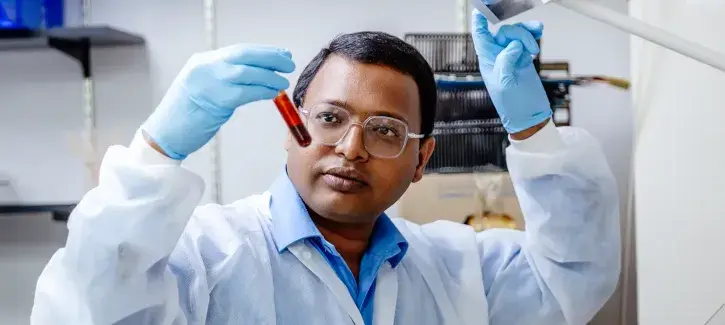
A Creighton University research team has received a five-year, $2.9 million award from the National Institutes of Health to advance a potential glaucoma treatment designed to lower pressure inside the eye and protect the retinal neurons responsible for vision.
According to the researchers, it is the first reported glaucoma compound to combine latanoprost with nitric oxide and hydrogen sulfide donors. Together, the three components could reduce eye pressure while protecting retinal neurons.
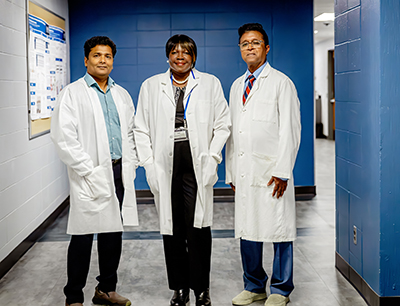
The interdisciplinary project brings together three Creighton researchers with complementary areas of expertise. Gopal Jadhav, PhD, MBA, specializes in medicinal chemistry; Catherine Opere, PhD, MBA, BPharm, brings expertise in ocular pharmacology and glaucoma research; and Somnath Singh, PhD, MPharm, BPharm, specializes in drug delivery and sustained-release methods.
Glaucoma is the second leading cause of blindness worldwide and is often called the ‘silent thief of sight’ because people may gradually lose peripheral vision without realizing they have the disease.
Existing medications, laser procedures and surgeries primarily treat glaucoma by reducing elevated intraocular pressure in the front of the eye. However, some patients continue to lose vision even when that pressure is controlled.
The Creighton team is aiming to develop a novel topical eye drop/ointment that could address both parts of the disease: reducing pressure in the front of the eye and protecting the retinal neurons and optic nerve at the back of the eye.
Designed to lower pressure and protect vision
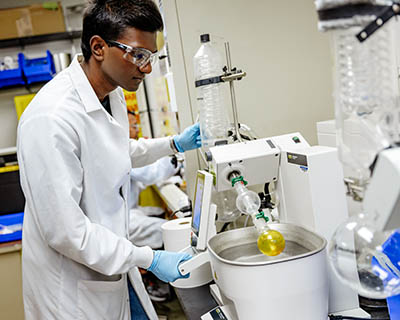
The experimental drug combines three components in one compound: latanoprost, nitric oxide and hydrogen sulfide. Latanoprost is used in existing glaucoma medications. The body naturally produces nitric oxide and hydrogen sulfide, but levels of both are reduced in eyes affected by glaucoma.
Each component can help reduce intraocular pressure. Nitric oxide and hydrogen sulfide may also help protect retinal neurons, giving the compound the potential to preserve the cells that transmit visual information from the eye to the brain.
Jadhav designed the compound with donors that release controlled amounts of nitric oxide and hydrogen sulfide in response to enzymes in the body. Achieving that controlled release was a significant medicinal chemistry challenge.
“At this moment, we would like to say it’s a novel concept,” Jadhav says. “We are the first to report it.”
Promising preliminary results
Preliminary animal studies have shown promising results. The compound reduced intraocular pressure by as much as 54%, compared with approximately 33% for the most potent drugs currently available, according to the researchers. It also preserved retinal neurons in animals with induced glaucoma.
The effects lasted approximately 52 hours, suggesting that the eye drop could potentially be administered every other day instead of daily. That longer duration could ultimately make treatment easier for older patients who may have difficulty administering eye drops/ointment or remembering a daily dose.
The studies also indicated that the treatment reached the back of the eye after being administered topically. Drugs used to treat other conditions affecting the back of the eye, such as macular degeneration and diabetic retinopathy, may require injections or implanted delivery devices.
“What was interesting is that, using topical eye drops, we could simultaneously reduce pressure in the front of the eye and protect retinal neurons in the back of the eye,” Opere says.
The researchers emphasize that the findings remain preliminary and considerably more study is needed before the treatment could advance toward clinical use. Singh says researchers will need to refine how the compound delivers each component and determine how the treatment could be adapted for different patients and stages of the disease.
Identifying the most promising compounds
The NIH award will allow the researchers to synthesize and evaluate more than 100 versions of the three-part compound. They will examine the compounds’ stability, safety and ability to release nitric oxide and hydrogen sulfide before selecting the top candidates for further testing.
The team will then evaluate how effectively the leading compounds lower intraocular pressure, how long their effects last, how they are distributed throughout the eye and whether they protect retinal neurons.
The project will also examine how the compounds may protect the retina. Researchers will study their effects on biological pathways associated with pressure buildup, tissue changes and retinal degeneration in glaucoma.
The researchers expect to identify approximately three leading candidates for further development.
“We want to move forward with the best compounds possible,” Opere says. “Hopefully, this award will allow us to identify some lead compounds.”
An interdisciplinary Creighton effort
The project grew from the researchers’ complementary areas of expertise. Jadhav synthesizes and refines the compounds; Opere evaluates their effects on eye pressure and retinal neurons; and Singh studies how the treatment can be delivered safely and over a sustained period.
The award builds on years of collaboration. Opere and Singh have worked together for about 15 years, and both began collaborating with Jadhav about four years ago.
Graduate students, master’s students and postdoctoral researchers have also helped generate the preliminary data supporting the project.
“The schools and Creighton provide an equally important platform. Without this basic platform, it’s not possible,” Jadhav says. “It’s an interdisciplinary team, bringing together the School of Medicine and the School of Pharmacy and Health Professions.”
Longer-term possibilities include improving the treatment’s formulation and sustained release, scaling up production and pursuing additional industry or small-business funding. Those steps will depend on what the researchers learn as they identify and refine the most promising compounds through the NIH-funded project.
Although considerable research remains, the team sees the potential to address a critical gap in glaucoma care by protecting vision while controlling eye pressure.
“It’s been very rewarding to work with people with complementary skills,” Opere says, “to come up with something that may change the way we treat glaucoma.”