Exploring the intersection of art and science through graphic medicine
What can a comic teach future physicians and health professionals about caring for patients?
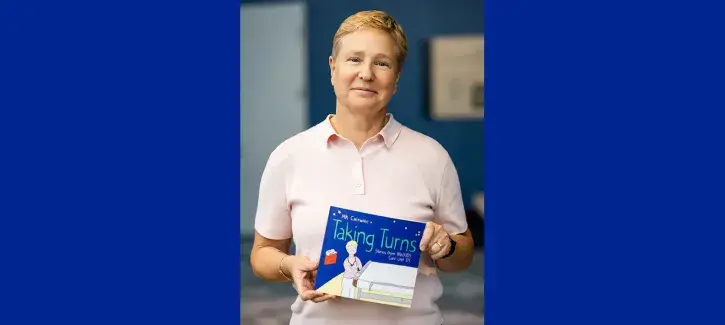
For nurse, cartoonist and educator MK Czerwiec, the answer is more than a story. It can be a way to understand illness and make space for the complicated emotions that accompany health and caregiving.
Czerwiec, a co-founder of the field of Graphic Medicine, recently brought her work to Creighton University through an exhibition at the Lied Art Gallery that explores health, illness, disability and caregiving through comics. The exhibition features work from Czerwiec’s career alongside contributions from Creighton students, Youth Enjoy Science (YES), members of the Winnebago Tribe of Nebraska and graphic medicine artists Sal Marx, Lynda Barry, Emil Wilson, Carol Tyler, Marek Bennett, Brian Fies, Trygve Faste, Roz Chast, Nicole Georges and Maureen Burdock.
Graphic Medicine has grown significantly since physician and artist Ian Williams coined the term in 2007. It describes the intersection of comics and health and illness, suggesting the larger idea that the graphic itself can become a form of medicine.
The exhibition has created a space where students, faculty, staff and community members can consider the human experiences that surround medicine and are not always captured through a diagnosis or clinical outcome.
Making space for the humanities in medicine

The School of Medicine incorporates the humanities into students’ education from their first year, complementing scientific and clinical training. Through the study of art, ethics and the human experience, students are encouraged to consider the perspectives of their patients and families, along with the deeper complexities of caring for individuals.
Associate professor and Richard L. Deming, MD, Endowed Chair in Medical Humanities Rachel Mindrup, MFA, said engaging with the humanities can help future healthcare professionals develop a deeper understanding of the people they will serve.
“I think studying different stories and different situations through a humanities lens helps build empathy,” Mindrup said. “It'll help our future students going into any health profession to put themselves into the shoes of their future patients.”
Though Graphic Medicine is a relatively new and evolving field, its accessibility makes it a powerful medium for student engagement. Through comics, students can communicate experiences that may be difficult to articulate otherwise. “If you have a piece of paper and a pencil, you can also do what MK is doing,” said Mindrup.
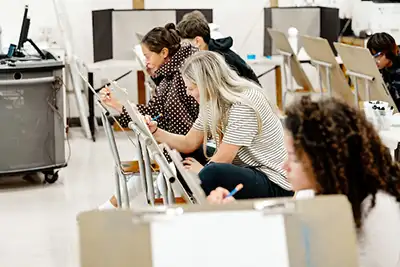
Since the exhibit opened, Czerwiec has led workshops with Creighton College of Arts and Sciences undergraduate students and first- and second-year School of Medicine students, providing an opportunity to explore their own experiences through art.
For medical students, these experiences can provide a way to process the complexities of healthcare while understanding the patient's perspective.
“The workshop truly emphasized the importance of connection with our patients and how that can be expressed through the arts,” said first-year School of Medicine student Belle Brooks. “Graphic medicine allows the viewer to have rare insight into the patient experience that I was not expecting.”
Improving patient understanding through art
The exhibition also reflects a broader commitment within Creighton’s College of Arts and Sciences to demonstrate how the arts and sciences can complement and inform one another.
Lied Art Gallery Director Jess Benjamin, MFA, sees that intersection as particularly valuable in preparing students for the realities of a future healthcare profession.
“There are real limitations to medicine and science,” Benjamin said. “But art knows how to break and bend the rules, and when you can combine creativity into science and medicine, then it's a much more wholesome experience for everyone involved.”
For students studying to become future healthcare providers, the intersection of art and science can open a different kind of learning space, one where there is room to imagine, reflect and engage with questions that don’t always have a single answer.
For College of Arts and Sciences student Summer McCeney, the exhibit also highlighted how the arts can help make healthcare information more accessible.
“Often, people do not fully understand their diagnoses, and the arts can help to bridge that gap and improve communication between patients and their providers,” said McCeney. “It has made me realize that comics can make it easier for people to comprehend complex medical language.”
Stories of care, told through art
Many of the works in the exhibit portray deeply personal experiences with illness, caregiving and a complex healthcare system. Together, they demonstrate how the act of creating and sharing art can itself become a form of care.
“A lot of these are very private moments in people's lives that they are sharing,” Benjamin said. “So, the graphic becomes the medicine itself.”
That idea lies at the heart of the exhibition and connects directly to the role of the humanities and arts within a health sciences education.
The opportunity to engage with art and creative expression alongside scientific and clinical education reinforces the idea that caring for patients requires more than knowledge of disease. It requires curiosity, empathy, communication and an understanding of the human experiences that shape health.
In bringing the arts and sciences together, the exhibition offers students a unique way to explore those experiences.
Visit the exhibition
Graphic Medicine: Comics, Care, and the Work of Justice by MK Czerwiec is open now through Nov. 15, 2026, in the Lied Art Gallery. This exhibition is made possible by the Richard L. Deming, MD, Endowed Chair in Medical Humanities, the Richard and Mary McCormick Endowment Fund for the Fine and Performing Arts, Kingfisher Institute, UNMC College of Public Health, and the Winnebago Comprehensive Healthcare System. All Department of Fine and Performing Arts events are funded, in part, by the generous support of the Grace Keenan Fund, the Anne Scheerer Fund, and other anonymous sources.
Gallery hours are Monday-Friday, 8 a.m. to 8 p.m. and Saturday-Sunday, 10 a.m. to 4 p.m. The gallery will be closed over Creighton’s fall break, Oct. 11-18.
Admission to the exhibition is free.
Visitor parking is located west of the Lied Education Center for the Arts and is accessed from Cass Street.