Federal grant advances quantum computing research at Creighton
The U.S. Department of Energy has awarded Thomas Wong, PhD, associate professor of physics at Creighton University, a four-year, $687,185 grant to advance research in quantum-computing algorithms and expand opportunities for undergraduates to lead research projects.
Wong’s proposal on “Advancing Quantum Walks for Quantum Computing” was the only project from Nebraska to receive a grant from the funding opportunity, which is part of the Department of Energy’s Established Program to Stimulate Competitive Research, a federal-state partnership that supports research in regions that have historically received less federal research funding.
The grant will support Wong’s research while creating opportunities for Creighton students to collaborate with researchers at Oak Ridge National Laboratory in Tennessee, contribute to research projects of their own and present their work at national and international conferences.
Putting undergraduates at the center of research
Wong’s approach to undergraduate research distinguishes his work from that of many larger research programs. Rather than serving primarily in supporting roles, Creighton students can lead projects from the initial research questions through publication.
“Most universities doing research in quantum computing will have PhD students or postdocs with undergrads in the group, but in a supporting role,” Wong says. “Whereas for me, a Creighton undergraduate leads each project from start to finish. They are the first author; learning about the project, overcoming challenges, proving the result and writing the paper. They’re going through the peer review process and getting feedback. It is just me and the student for that paper.”
Wong documented nine years of successful undergraduate research at Creighton, including publications in peer-reviewed journals, as part of his grant proposal. He says the track record helped address questions about whether undergraduates could undertake the proposed work.
“And, finally, we’ve got to the point where I’m able to convince people that this type of work is doable at Creighton,” Wong says.
The Department of Energy grant builds on that model, with Wong expecting his students to take ownership of the project’s three main research thrusts. Each thrust will have milestones throughout the four-year grant period, with a goal of producing approximately 12 research papers.
As students graduate, others will have opportunities to join the project and continue the work. Some students may remain involved for multiple years and contribute to several milestones.
Connecting Creighton students with national research

The award also creates opportunities for collaboration with Oak Ridge National Laboratory, including co-advising, conference participation and ongoing knowledge exchange between researchers.
Wong has existing professional connections with scientists at Oak Ridge’s Quantum Science Center, one of the Department of Energy’s flagship quantum research centers. He plans to build on those relationships through the grant.
Creighton students will be encouraged to apply for summer internships at Oak Ridge and participate in conferences and poster sessions hosted by the laboratory. Wong also plans to visit Oak Ridge each summer to teach short courses or present research conducted with Creighton students.
“The idea is that we want to facilitate knowledge sharing between what we do here at Creighton and what they do at the National Lab,” Wong says. “As we continue to share expertise, there'll be natural areas that might arise for our future collaboration.”
For students, those connections offer a chance to engage with the broader quantum computing research community and explore potential paths for graduate study and careers in science.
Building on student research experience
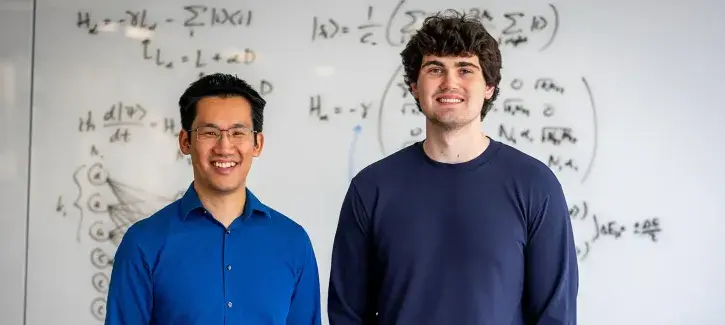
Jonas Duda, a mathematics and physics junior, began conducting research with Wong the summer before his first year at Creighton. Since then, they have written three papers together—two published and one undergoing peer review. Duda will lead one of the project’s research thrusts.
“My work now has been the culmination of chipping away at something that was once super daunting. It’s very cool that we are working with an international research lab, which allows me access to projects I may not have had access to,” Duda says. “I finally feel like I am at the stage that I can fully participate with these new colleagues and hopefully contribute something, which is an awesome feeling.”
The four-year grant will provide sustained support for Wong and his students, including funding for research salaries and summer research opportunities.
For Wong, the opportunity to connect students with researchers beyond Creighton is an important part of their development.
“It's important for them to be connected to the broader quantum computing community; to see where they might fit in as they explore potential careers or study for graduate school. It’s a valuable part of their education,” says Wong. “They should understand the global nature of science.”