Reimagining Population Health in the Age of Artificial Intelligence
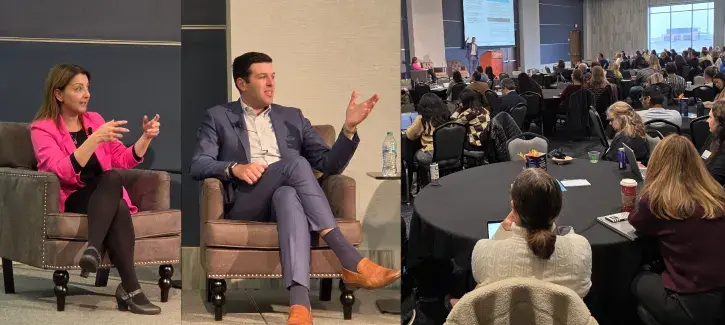
At Creighton University’s Symposium on Population Health held Nov. 5, Mandy Cohen and Jared Augenstein described AI as a powerful opportunity to expand access and improve population health—but only if health systems build trust, protect equity and choose health over revenue.
When Mandy Cohen was a young physician in Boston, a 24-year-old graduate student came to her clinic because she was losing her hair.
Over the course of several months, Cohen ordered blood tests, checked for thyroid disease and autoimmune conditions, and eventually ordered a CT scan. Everything came back normal, but the patient continued to feel worse.
The breakthrough came when a medical assistant asked whether the woman had enough to eat. With that fundamental question, Cohen learned that the patient had left an abusive relationship, was living in her car and had limited access to food.
Cohen had easily ordered thousands of dollars’ worth of tests by then. Getting the patient connected with stable housing, food and safety resources to address the actual issue took several additional months.
“It was the system that really failed,” Cohen said.
AI Potential for Round-the-Clock Expertise
That story framed the keynote presentation, “Reimagining Population Health in the Age of Artificial Intelligence.” Cohen, MD, MPH, former director of the Centers for Disease Control and Prevention, and Jared Augenstein, MPH, senior managing director at Manatt Health, presented AI as both a technological breakthrough and a test of the health care system’s priorities.
Cohen asked the audience to imagine needing care for a rash or worsening headache and needing to see a physician. She asked those who would be willing to see an AI clinician to raise their hands. Few initially did. But when the choice became seeing an AI clinician today or a human clinician weeks or months from now, far more hands rose.
The response reflected a familiar problem: health care is expensive, complex and difficult to access. AI could potentially make clinical expertise available around the clock, reduce waiting times and extend the reach of clinicians and community health workers.
“We are at this inflection point,” Cohen said. “We can make some choices about how we shape a system, what we pay for, what are these platforms going to be used for.”
The Promise of AI Systems
AI systems can synthesize large amounts of information, identify patients at risk, translate health information into multiple languages and help public health officials detect clusters of symptoms. Augenstein cited an automated insulin-dosing chatbot that helped patients with Type 2 diabetes reach optimal dosing in about 15 days, compared with more than 56 days under usual care. A Geisinger program used machine learning to identify patients overdue for colonoscopies, nearly doubling completion rates and associating the intervention with almost a halving of two-year mortality.
The promise, Augenstein said, is a form of abundance: more expertise, monitoring and population health infrastructure than human labor alone can provide.
But technology alone will not repair a fragmented system. Cohen pointed to hepatitis C and HPV as examples of treatments and preventive tools that already work yet remain underused because of problems with access, follow-up and system design.
She also described a British program that used AI to read chest X-rays. Although the technology accurately interpreted the images, patients still faced delays in follow-up scans and subsequent care.
“We have to care about where it fits into the system,” Cohen said.
Five Tensions Shaping Health AI
Augenstein identified five tensions shaping the future of health AI: technological pace, workforce transformation, equity, payment and trust.
AI could help address workforce shortages and reduce administrative burdens. It could also create conflicts over scope of practice, contribute to clinicians losing skills when they defer too heavily to algorithms, and widen the gap between well-resourced health systems and rural, community and safety-net providers.
Equity is another concern. If algorithms learn from incomplete or biased data, they can reproduce disparities at greater speed and scale. Limited broadband access could also leave some communities behind, while a two-tier system could emerge in which people who cannot afford human-led care receive lower-quality AI-based services.
“These are design choices,” Augenstein said. “Now is the time that we have to decide to make the choices that lead us in the right direction.”
Health and Health-Related Social Needs
Payment incentives could push AI in the wrong direction as well. Augenstein said some tools are being used to increase billing intensity rather than improve outcomes. Cohen contrasted a system built to respond to strokes with one designed to prevent them through blood-pressure control, medication adherence and attention to social needs.
In North Carolina, Cohen helped develop a Medicaid program that paid for food, housing support and mold remediation to prevent asthma attacks. The program demonstrated that paying for the conditions that keep people healthy can reduce expensive emergency and hospital care.
“We’re trying to achieve health, not healthcare,” Cohen said.
Trust, both speakers argued, will determine whether AI delivers on its promise. Cohen described three requirements: transparency and evidence, strong relationships and measurable results. “Medicine is still a human endeavor,” Cohen said. “Health is still a human endeavor.”
Augenstein said trust must include clear rules about liability, privacy, regulation and clinical oversight. The speakers also urged educators to prepare health professionals for roles that emphasize judgment, relationships, curiosity, communication and supervision.
“The relational aspects of clinical care and health care delivery are going to become even more important,” Augenstein said.
Agency to Shape Future
The future of population health, they suggested, will depend on generating evidence about what works, establishing rules for safe use, purchasing tools without inflating costs and redesigning care around the capabilities of both people and machines.
AI may not transform healthcare overnight. But the choices made now will determine whether it expands access, narrows disparities and improves health—or simply accelerates the weaknesses of the existing system.
“You have a lot of agency right now to help shape that future,” Cohen said.