EU ambassador discusses global issues during Creighton visit
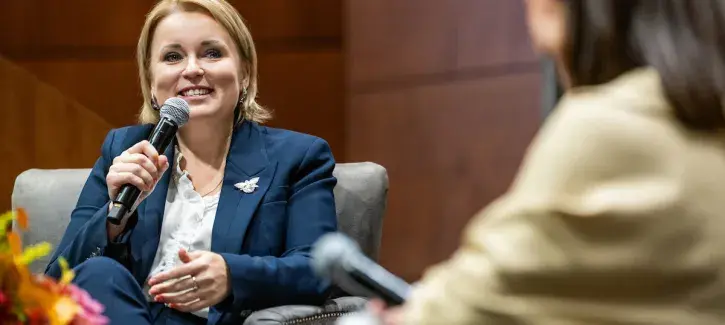
Creighton University welcomed the ambassador of the European Union to the United States, Jovita Neliupšienė, to its Omaha campus on Tuesday, Sept. 22, where she offered remarks and participated in a Q&A session moderated by two members of the Creighton faculty.
Neliupšienė, who has served as the EU ambassador to the U.S. since 2024, covered a range of topics, including the importance of global partnerships in addressing the needs of citizens worldwide, the EU’s response to military conflict between Russia and Ukraine, global responses to the rise of artificial intelligence and Nebraska’s role in global trade with European countries.
“When we think about where international relations are actually happening, is it happening between Brussels and Washington? The answer is no,” Neliupšienė told the estimated 200 students, faculty, staff and special guests in attendance. “Transatlantic relationships are actually happening here – between people, between researchers, between universities, and business and agriculture.”
This was not Neliupšienė’s first time on the Creighton campus. In 2007, she was a visiting scholar completing her dissertation and even considered staying in Nebraska until a faculty mentor from the Department of Political Science and International Relations encouraged her to give back to her home country of Lithuania.
“When I was a student here, Lithuania had just become a member state of the European Union, and I could never imagine that one day I would return here as an ambassador of the EU to the United States,” she said. “There was one person who probably had this idea [that I would] ... Dr. Terry Clark. Life takes unexpected turns and my message to students is very simple: Never say never.”
In addressing students, Neliupšienė shared two global engagement opportunities offered by the Diplomatic Service of the European Union: funded traineeships for recent graduates in diplomatic affairs and the Schuman Challenge foreign affairs contest.
Following the ambassador’s remarks, she answered questions prepared by two faculty member moderators: Erika Moreno, PhD, professor and chair of the Department of Political Science and International Relations, and Kristie Briggs, PhD, a professor of economics.
During the Q&A, Neliupšienė offered perspectives on how the European Union has navigated challenges such as financial crises, Brexit and the COVID pandemic; how artificial intelligence and global conflict have shaped the EU’s perspectives on moves toward renewable energy strategies; and how important it is, as the United States marks its 250th anniversary, to maintain a centuries-long history of diplomatic and economic cooperation. In the last instance, she used Creighton basketball as an analogy.
“No team wins by standing on the side of the court. You pass, you trust, you defend, you adapt and, when the moment comes, you shoot,” she said. “Americans and Europeans have been on the same team for generations. The world is changing, so let’s keep passing, let’s keep defending, let’s keep investing, let’s keep innovating and, when the moment comes, let’s shoot and shoot together.”
As part of her visit, a traveling exhibit titled "The EU Ambassador's Book Collection: Words That Unite, Stories That Connect" was on display outside the lecture hall.
A recording of the ambassador’s address can be accessed online.
More About the Ambassador
Neliupšienė assumed her current role in 2024 following a distinguished career in public service. In the decade prior, she served Lithuania in a variety of roles, including as vice minister of foreign affairs (2022-2024), vice minister of economy and innovation (2020-2022), chancellor and state secretary of the Ministry of Foreign Affairs (2020), and the country’s ambassador to the European Union (2015-2020).
She also spent time as a lecturer at Vilnius University from 2006 to 2012, specializing in Belarusian and Ukrainian studies.